July 20, 2007
Interview: 'Girls of Riyadh' author Rajaa Alsanea
 By Christina Gillham
When Rajaa Alsanea's "The Girls of Riyadh" hit bookstores in the Middle East in 2005, it caused a furor. Referred to by some as a "Sex and the City" for Saudi Arabia, the book delved into the social, romantic -- and sometimes sex -- lives of its four female characters. Published first in Lebanon -- and published in the United States this month -- the book almost immediately made its way to Saudi Arabia, where it was denounced by religious conservatives as immoral and hailed by reformists as a much-needed condemnation of Saudi Arabia's restrictive society.
Alsanea, 24 years old at the time, was propelled to stardom, making appearances on TV, receiving supportive phone calls from the royal family and an endorsement from no less a figure than the king's labor minister and close adviser, Ghazi al-Gosaibi. "The Girls of Riyadh" explores the lives of four young women -- Lamees, Sadeem, Gamrah and Michelle. Their stories are told by a narrator in a series of postings on an Internet chat room.
The women, like their creator, are upper-class Sunni Muslims whose lives revolve around various romantic entanglements, shopping, school and struggling against their society's strict moral code. Alsanea wrote the book while in college, where she studied dentistry. Now living in Chicago, she is doing her residency in endodontics (root canal) and studying for her master's degree in oral sciences. She spoke to NEWSWEEK's Christina Gillham.
Source: [Newsweek]
Continue reading "Interview: 'Girls of Riyadh' author Rajaa Alsanea"
Posted at 01:29 PM in Culture almighty, Interview, Media Watch | Permalink | Comments (0) | TrackBack
March 20, 2007
An Iraq war translator's take on US language failure
Last year, the Hamilton-Baker commission reported that the U.S. Embassy in Baghdad had only six fluent Arabic speakers on its staff -- a fact that went largely unnoticed next to ostensibly bigger and more pressing problems with the war in Iraq. But one wonders if a failure to communicate isn't the root problem of the fiasco. How can the U.S. reach hearts and minds if they can't even speak the language?
The lack of Arabic translators in Iraq appears to stem from a Bush Administration decision to outsource translation services to private contractors. Called "linguistic support," these companies, two of the largest of which are Titan Corporation and DynCorp International, have received billions of dollars to provide language interpreters to the Iraq reconstruction effort.
But many of the supposed "translators" sent to Iraq were untrained, had poor language skills, or couldn't speak Arabic at all. In many cases the contractors appear to have conducted no screenings or interviews with prospective translators. And Titan Corporation interpreters are accused of involvement in two cases of prisoner abuse in Iraq and one case of espionage at Guantánamo Bay, Cuba. For an inside look at the U.S.'s failure to communicate, Radar spoke with Dustin Langan, who worked as a translator in Iraq for defense contractor MZM Incorporated for 11 months between 2003 and 2004.
Source: [Radar Online]
Continue reading "An Iraq war translator's take on US language failure"
Posted at 12:58 AM in Interview, War | Permalink | Comments (1) | TrackBack
August 25, 2006
Sheik Hamad: 'The Street Is Not With Us'

By Lally Weymouth
In the days before the united Nations Security Council passed its Lebanese ceasefire resolution, a group of Arab League emissaries flew to New York to demand last-minute revisions in the French-U.S. draft resolution. The Arabs' objection: the draft emphasized the security of Israel's border without demanding the immediate withdrawal of Israeli troops and called for an international force with real power, which Lebanon opposed. The Arab delegation pressed its case -- and finally won. The negotiations were underway when the group's leader, Sheik Hamad bin Jassim bin Jabr al-Thani, foreign minister and deputy prime minister of Qatar, spelled out his thinking to NEWSWEEK's Lally Weymouth. Excerpts:
WEYMOUTH: What [were] the Arab League's reservations about the draft resolution?
AL-THANI: In Lebanon, Hizbullah and the Shia are around 40 percent of the population, so if the Lebanese government went to enforce it [the draft resolution] ... we might see a civil war again.
Does the Lebanese Army have the power to disarm Hizbullah?
Why do they have to take on Hizbullah? They have to take the place of Hizbullah, and Hizbullah has to become a normal political party.
Source: [Newsweek]
Continue reading "Sheik Hamad: 'The Street Is Not With Us'"
Posted at 01:41 PM in Interview, La Revolutione, War | Permalink | Comments (0) | TrackBack
August 24, 2006
Interview: Are Islam and the West incompatible?
Since last summer's terror attacks on London, British authorities have focused a keen eye on radical Muslim groups in the United Kingdom. The revelation this month of the purported plot to destroy U.S.-bound airliners over the Atlantic Ocean, and the belief that its suspects may be tied to terrorists in Pakistan, have only heightened British concerns about so-called homegrown terrorists.
To fight what security officials consider dangerous elements, the government has cracked down on groups believed to support terrorist activities. Anjem Choudary, 39, has been associated with two such organizations that have been outlawed. A lawyer from Ilford, East London, and a longtime Muslim activist, he was a leader of Al Muhajiroun, a U.K.-based group committed to the creation of a global Islamic state. Al Muhajiroun was dissolved in 2004 and its founder, Omar Bakri Mohammed, deemed "not conducive to the public good" by the British government shortly after he fled to Lebanon in the wake of the July 7, 2005, London bombings.
Choudary was also a spokesperson for Al Ghurabaa, widely believed to be a successor group to Al Muhajiroun. Last month the British government banned Al Ghurabaa under new antiterror legislation that prohibits the glorification of terrorism. According to U.K. media reports, Rashid Rauf, a principal target in the investigation into the recent airline plot, was acquainted with members of Al Muhajiroun. NEWSWEEK's Karla Adam recently spoke to Choudary in Walthamstow, East London, a neighborhood where several of the suspects in the airliner plot were arrested. Excerpts:
Source: [Newsweek]
Continue reading "Interview: Are Islam and the West incompatible?"
Posted at 05:00 PM in Culture almighty, Interview, Religion | Permalink | Comments (5) | TrackBack
June 05, 2006
Interview: HM Queen Rania of Jordan
 By Margarette Driscoll
If the veiled woman has become the symbol of the culture clash between East and West, Queen Rania is her nemesis. Jordan's young queen, who has reigned over the Middle Eastern kingdom with her husband King Abdullah for nearly seven years, is on a charm offensive to present a new kind of Arab woman to the world.
Rania, 35, the privileged daughter of a paediatrician, educated in international schools, has never worn the veil, nor will she. "In Jordan we believe there should be no coercion under Islam," she says. "Unfortunately, people think of the Middle East as a monolithic whole, but each country has its own characteristics, its own level of stability and security and its own level of openness for women."
It irks her that westerners in any case see the veil as a sign of helplessness and oppression: "To us it's a sign of modesty and devotion to God and it's up to women whether they wear it." A mother of four who admits she was "terrified" when she discovered that she was to become queen, Rania describes herself as "an Arab woman through and through", but has the international look of a supermodel.
Source: [The Times]
Continue reading "Interview: HM Queen Rania of Jordan"
Posted at 12:25 AM in Interview | Permalink | Comments (6) | TrackBack
February 18, 2006
Yemeni editor discusses Prophet caricatures from jail
By Rod Nordland
Mohammed al-Asaadi is an improbable martyr to a free press. As the editor in chief of the generally pro-government Yemen Observer, a weekly English-language newspaper owned by Yemeni president Ali Abdullah Saleh's media adviser, al-Asaadi has not been party to the sort of controversies that have seen many Yemeni journalists jailed in recent years. But when his newspaper ran an article about the Danish cartoons depicting the Prophet Muhammad as a terrorist, Asaadi decided to reprint the cartoons -- albeit with a large X censoring most of them, and an article denouncing them. On Feb. 11, he was arrested and charged with insulting the Prophet. He is now in jail in Sanaa, the capital of Yemen, awaiting trial. Newsweek arranged for a visitor to take a cell phone to him today, and Newsweek's Rod Nordland interviewed him by phone.
NEWSWEEK: Is this your first time in jail?
Mohammed al-Asaadi: It's the first time ever I've been a prisoner, or even in front of a judge.
How are the accommodations?
I'm in a temporary prison, awaiting a hearing, so it's not so bad. It's a basement, and we have to buy everything we need, even bottled water. There are 15 of us sharing one big room and one toilet, but the others aren't common criminals. A couple are journalists, because it's the prison of the prosecutor for press and publications.
Source: [Newsweek]
Continue reading "Yemeni editor discusses Prophet caricatures from jail"
Posted at 09:02 AM in Cartoon rows, Interview | Permalink | Comments (2) | TrackBack
February 09, 2006
Hirsi Ali: 'Everyone Is Afraid to Criticize Islam'
Ayaan Hirsi Ali, the Dutch politician forced to go into hiding after the murder of filmmaker Theo van Gogh, responds to the Danish cartoon scandal, arguing that if Europe doesn't stand up to extremists, a culture of self-censorship of criticism of Islam that pervades in Holland will spread in Europe. Auf Wiedersehen, free speech.
SPIEGEL: Hirsi Ali, you have called the Prophet Muhammad a tyrant and a pervert. Theo van Gogh, the director of your film "Submission," which is critical of Islam, was murdered by Islamists. You yourself are under police protection. Can you understand how the Danish cartoonists feel at this point? [See related story]
Hirsi Ali: They probably feel numb. On the one hand, a voice in their heads is encouraging them not to sell out their freedom of speech. At the same time, they're experiencing the shocking sensation of what it's like to lose your own personal freedom. One mustn't forget that they're part of the postwar generation, and that all they've experienced is peace and prosperity. And now they suddenly have to fight for their own human rights once again.
SPIEGEL: Why have the protests escalated to such an extent?
Source: [Der Spiegel]
Continue reading "Hirsi Ali: 'Everyone Is Afraid to Criticize Islam'"
Posted at 07:54 AM in Cartoon rows, Interview | Permalink | Comments (2) | TrackBack
November 13, 2005
King Abdullah: Terror won't divide Jordan, Iraq
AMMAN (Petra) -- His Majesty King Abdullah on Saturday said the Kingdom will not permit terrorists to divide Jordanians and Iraqis. Iraqis living in Jordan, he said, are "dear brothers" who live in dignity in their second homeland. "Their security is our security and we will not accept that any harm should come to them," he said.
In an interview with the Jordan News Agency, Petra, King Abdullah warned that no one should exploit Wednesday's terrorist acts to harm Jordanian-Iraqi relations and said the Kingdom will continue to be a safe haven for every Iraqi who is forced, by circumstances in the neighbouring country, to come and live in Jordan.
The King said counterterrorism efforts should include confronting those who justify terror or incite others to commit acts of terror. Those who incite and justify terrorism and those who actually commit acts of terror are equally guilty for the crime, he said. The King told Faisal Shboul, director general of Petra, that any individual, group or party that justifies terrorism, that advocates violence against innocents or that defends such acts and ideas is unacceptable.
Source: [The Jordan Times]
Continue reading "King Abdullah: Terror won't divide Jordan, Iraq"
Posted at 02:55 PM in Interview, Jordan in the news, Politics | Permalink | Comments (0) | TrackBack
November 12, 2005
Mary Nazzal: Amman bombs designed for carnage
 On Wednesday evening, three five-star hotels in the heart of Amman, Jordan, were struck by powerful blasts which killed at least 57 people and injured up to 300. Al-Qaida in Iraq claimed that four of its members carried out the attacks to hit "enemies of the faith, Jews and crusaders" who congregated in Amman.
The hotels had been identified in the media as US-owned establishments, a statement denied by Mary Nazzal-Batayneh, owner-representative of the Radisson SAS, one of the bombed hotels. "Firstly, news reports have been indicating that the Radisson SAS was specifically attacked because it is an American hotel.
"I want to make it clear that the Radisson SAS is a Scandinavian chain and owned by Palestinian-Jordanians," Nazzal-Batayneh said in a statement released to the media. A wedding hall seems to have been the target of the attack on the Radisson SAS. Aljazeera.net's senior editor Firas al-Atraqchi interviewed Nazzal-Batayneh, who had just returned to Amman from London, where she has a home.
Source: [Aljazeera.net]
Continue reading "Mary Nazzal: Amman bombs designed for carnage"
Posted at 10:54 PM in Interview, Jordan in the news, Terrorism | Permalink | Comments (0) | TrackBack
September 09, 2005
SPIEGEL Interview with Syrian President Assad
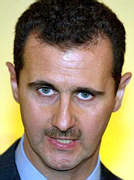 Syrian President Bashar Assad discusses initial stabs at democracy in his country, the outlook for peace in the Middle East and Syria's withdrawal from Lebanon.
SPIEGEL: Mr. President, there are tentative movements toward democracy here and there in the Arab world. But there is little evidence of that in Syria. Why not?
Assad: Well, it just happens that the Arab states develop at different rates and under different historical conditions. Egypt, for example, has not experienced as many coups as Syria. Besides, Cairo signed a peace treaty with Israel, whereas we remain in neither a state of war nor a state of peace with Israel. Incidentally, our development only began a few years ago, so of course expectations will vary widely. But the main issue is that we in Syria have at least opened up a dialogue about it.
SPIEGEL: But it's taking longer than many would like.
Assad: The pace of our development depends upon the challenges that we must face, which we cannot always influence. For example, we have to deal with foreign powers meddling in our internal affairs.
Source: [Der Spiegel]
Continue reading "SPIEGEL Interview with Syrian President Assad"
Posted at 02:32 PM in Interview | Permalink | Comments (0) | TrackBack
June 01, 2005
The World Has Changed: King Abdullah
Last week king Abdullah sat down at the start of the World Economic Forum in Jordan and gave Newsweek's Lally Weymouth his assessment of the war in Iraq, his hopes for the ongoing Israeli-Palestinian conflict and his views on a prospective pardon for Iraqi Deputy Prime Minister Ahmad Chalabi (once convicted of bank fraud in Jordan). The young monarch also praised President Bush's calls for democracy and outlined his own plans for political reform. After the interview, the king drove to a waiting helicopter. Jumping out of his car, he took off his suit jacket, rolled up his shirt sleeves and climbed into the pilot's seat to fly back to Amman. Interview excerpts:
WEYMOUTH: Could you elaborate on rumors that you are going to pardon Ahmad Chalabi?
KING ABDULLAH: [Iraq's] President [Jalal] Talabani asked me to look into the Chalabi case to see if we can't find a solution to the problem. Obviously, Ahmad Chalabi is a senior member of the Iraqi government, and we believe in a strong relationship with Iraq, so we should put our best efforts into solving this problem. The issue with Chalabi is an economic problem, not a political one. It is [about] money owed to people, not to the government.
Source: [MSNBC]
Continue reading "The World Has Changed: King Abdullah"
Posted at 12:04 PM in Interview, Jordan in the news | Permalink | Comments (0) | TrackBack
April 20, 2005
JORDAN: Special report on honour killings
AMMAN (IRIN) -- It was the case of a 16-year-old Jordanian girl in 1994, killed at the hands of her brother because she had been raped by another brother, which led Rana Husseini to campaign actively for the prevention of honour killings. Honour killings are the murder of a woman or girl accused of tainting family honour.
Husseini, a journalist, has been calling on the government to implement stricter laws and punishments for those who commit these crimes. She has written extensively on the subject and attends court proceedings to follow up on cases.
"[My work involves] exposing these crimes for what they really are, cold-blooded and senseless murders, and struggling with the law to restore dignity to women and consider them full human beings," she told IRIN in the capital Amman. "The problem of honour crimes is not restricted to any particular class of Jordanian society or certain regions," she added.
Source: [Reuters]
Continue reading "JORDAN: Special report on honour killings"
Posted at 10:11 AM in 'Honor' Crimes, Interview | Permalink | Comments (0) | TrackBack
April 17, 2005
Jordanian born princess praises Emirati women
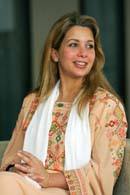 DUBAI (AFP): One year after marrying Dubai's Crown Prince Sheikh Mohammed bin Rashid al-Maktoum, Princess Haya bint al-Hussein of Jordan believes Emirati women are an example to Arabs of how to combine modernity and tradition. In her first interview with Western media since her wedding, Princess Haya, talked of her belief that women can be modern and still respect Arab and Muslim traditions, as they do in the United Arab Emirates.
"In my work and in our family gatherings I have closely been watching women in the Emirates, and I am in great admiration of them ... and I never fail to be amazed at the way in which they combine modernity with Arab and Muslim traditions," she said.
"I have so much respect for the way they balance the two, and genuinely believe that an Emirati woman can serve as an example of a modern Muslim woman, to the rest of the Arab and Muslim worlds ... They are proof to me that an Arab woman can be modern without feeling the need to be Westernized, as exemplified in the role of Sheikha Fatme" the president of the General Women's Union, and widow of the former president of the U.A.E. Sheikh Zayed bin Sultan, she said.
Source: [Daily Star]
Continue reading "Jordanian born princess praises Emirati women"
Posted at 06:52 PM in Interview | Permalink | Comments (4) | TrackBack
March 16, 2005
King Abdullah Open to Constitutional Monarchy
King Says Bush Deserves Credit for Sparking Democracy in Middle EastMar. 15, 2005 - President Bush hosted Jordan's King Abdullah II in an Oval Office meeting today. The two men are publicly enthusiastic about some of the recent changes in the Middle East -- among them, the elections in Iraq, a sliver of democracy emerging in Egypt and Saudi Arabia, and massive protests in Lebanon calling for the Syrian military to withdraw. After the White House meeting, King Abdullah spoke with ABC News' Peter Jennings. Following is a transcript of the interview:
PETER JENNINGS: Let me ask you first, sir, what is happening in the region?
KING ABDULLAH: Oh, there's so many things happening in the region. We have obviously the issue of reform in Egypt, we have elections coming up in Lebanon. Iraq, last month had very successful elections, and we're looking for help, a momentum that moves toward new elections at the end of the year, which will be I think the new face of Iraq. Obviously we have the problems in Lebanon and Syria. It's going to be a very busy year for all of us.
JENNINGS: What do you think it all means? Taking just what most Americans regard as the positive note, elections in Palestine, elections in Iraq, the slight elections in Saudi Arabia and the slight changes in Egypt?
ABDULLAH: Well, I think that there's a positive trend that reflects the desire of the people. I think that, you know, President Bush called for Middle East reform last year, it had initially been taken in the wrong context by Arab countries as something being forced upon them, but it created debate inside of Arab society and I think we're seeing the fruits of that. I think people are expecting leaders to reform, and are demanding from their governments to move forward.
Source: [ABC News]Continue reading "King Abdullah Open to Constitutional Monarchy"
Posted at 09:55 AM in Interview, Politics | Permalink | Comments (0) | TrackBack
March 12, 2005
King Abdullah: 'Iraq is the Battleground -- the West against Iran'
King Abdullah II bin Al Hussein, descendant of the Prophet Muhammad, is the fourth ruler of the Hashemite Kingdom of Jordan and the great-grandson of his namesake, the kingdom's founder. Born on January 30, 1962, to King Hussein's second wife, the British-born Princess Muna, he is the eldest of Hussein's sons and was proclaimed crown prince at birth. When Abdullah was three years old, however, Hussein transferred that title to his own younger brother, Hassan.
After his early schooling in Amman, Abdullah was educated in private schools in England and the United States and then, in 1980, embarked on a military career, attending Britain's Royal Military Academy at Sandhurst. For the next nineteen years, he rose through the ranks of the Jordanian army, eventually serving as commander of the Royal Jordanian Special Forces and as special operations commander. Along the way, he took classes at Oxford and Georgetown universities and further military training at Fort Knox and the Royal Staff College at Camberley, United Kingdom.
In 1998, he assumed the rank of major general, which he held when he was proclaimed crown prince by his father on January 24, 1999. Abdullah assumed the throne when his father died on February 7, 1999. Abdullah and his wife, Queen Rania, have two sons and two daughters. On January 11, 2005, Robert Satloff, executive director of the Washington Institute for Near East Policy, interviewed King Abdullah II at his private office in a secluded compound outside of Amman.
Fighting Extremism
Middle East Quarterly: How do you identify and energize the "silent majority" of Muslims that opposes Islamist extremism?
Abdullah: It's just not good enough to say, "Fine, we are God-fearing Muslims, this is what we believe in and this is the line that we draw in the sand." The real question for us is how do we take the battle to the street and start winning the street war. It's not just inside the Muslim world. It's also a battle for our friends in Europe and in the West.
Souce: [Middle East Quarterly]
Continue reading "King Abdullah: 'Iraq is the Battleground -- the West against Iran'"
Posted at 06:45 AM in Interview, Politics | Permalink | Comments (0) | TrackBack