March 21, 2007
Plans for 'Desert Louvre' provoke outrage in France
 By Molly Moore
PARIS -- The most visited museum in the world -- the Louvre -- is set to open its first international outpost on a currently uninhabited island off the coast of Abu Dhabi in the United Arab Emirates. In the largest foreign museum deal in French history, the petro-rich but museum-poor Persian Gulf emirate agreed last week to pay France $1.3 billion to borrow the Louvre's name and hundreds of its artworks, as well as treasures from the Picasso Museum, Pompidou Center, Chateau de Versailles and other French museums.
French President Jacques Chirac described the mega-museum agreement as an important way of bridging what the "world considers a clash of civilizations" between Islam and the West. To many French art experts and historians, however, it represents little more than putting the nation's priceless patrimony up for rent.
"Appalling!" declared Daniel Alcouffe, 68, an honorary curator of the Louvre who headed its decorative arts department for nearly two decades. He echoed the outrage expressed by some of the country's most prominent art experts and historians. "It's a shame to see France selling out its heritage," he said. The "Desert Louvre," as the French press has dubbed the deal, is part of a revolutionary initiative by France to expand its global influence through its vast cultural heritage and holdings -- the one realm where it remains a dominant world power -- in the face of its shrinking diplomatic and economic clout.
Source: [Washington Post]
Continue reading "Plans for 'Desert Louvre' provoke outrage in France"
Posted at 09:00 PM in Culture almighty, Entertainment, Features | Permalink | Comments (0) | TrackBack
November 22, 2006
Europe's Muslims: Beyond the Veil

By Fareena Alam
The Dutch government just announced that it's seeking to ban the Muslim veil in public places. The Vatican has declared that veiling shows disrespect for local cultures and sensibilities. German officials in North Rhine-Westphalia say they will discipline Muslim teachers who wear headscarves in defiance of a ban imposed in May. In Britain, Jack Straw recently threw fuel on the fire by suggesting that this bit of traditional Muslim garb "separates people" and hinders integration.
"Communication requires that both sides see each other's face," said Britain's former foreign minister, displaying a mastery of cross-cultural sen-sitivity. "You not only hear what people say, but you also see what they mean." British Muslims immediately wondered how Straw's former cabinet colleague, ex-Home secretary David Blunkett -- blind since birth -- ever did his job.
Perhaps Straw did not intend to wound. But it had been a bad week already. Conservative leader David Cameron was taking jabs at what he called "Muslim ghettos." British tabloids railed about a Muslim cabby who allegedly refused to drive a blind woman because having her dog in the car offended his religious beliefs. Even Prime Minister Tony Blair couldn't hold his peace and called the veil a "mark of separation."
Source: [Newsweek]
Continue reading "Europe's Muslims: Beyond the Veil"
Posted at 12:52 AM in Features, Religion | Permalink | Comments (3) | TrackBack
November 13, 2006
Saudi bloggers push limits to speed reform
 By Faiza Saleh Ambah
JIDDAH, Saudi Arabia -- When he was a college student in Washington state, Saudi Arabia's most popular blogger, Fouad al-Farhan, donned a T-shirt emblazoned with "Animal Rights Equals Human Rights" and slept on the campus lawn during a hunger strike protesting the slaughter of foxes.
That type of freedom during six years in the United States gave Farhan a taste for expressing himself that he was unable to satisfy when he returned to Saudi Arabia in 2001. "You can't write whatever you want in the newspaper here; you can't even lift up a poster in protest," said Farhan, 31, a computer programmer who attended Eastern Washington University in Spokane. "On the blog, it's a different world. It was the only way to express myself the way I wanted."
Source: [Washington Post]
Continue reading "Saudi bloggers push limits to speed reform"
Posted at 12:40 AM in Features, La Revolutione, Weblogs | Permalink | Comments (1) | TrackBack
November 12, 2006
Royal Emirati's career fuels young women's dreams
 By Hassan Fattah
For Sheika Lubna al-Qassimi, the most memorable moments typically happen in the shopping malls and public gatherings of this rapidly growing nation, not in the halls of power she navigates every day. They come when young Emirati women approach her to take their photograph with her, tell her their dreams or, best of all, ask her for career advice.
During those moments, she says, she realizes how much has changed for women here since she first started out in business, but she also sees how much farther they still have to go. "I had to prove that stamina and delivering have nothing to do with gender," she told a group of young entrepreneurs recently. "We are the ones who usually discourage ourselves even before anyone else discourages us."
After decades of pushing the barriers in a region where women have traditionally been kept out of the public sphere, Sheika Lubna now towers as one of the country's most influential women. She is the first woman here to be a minister, but no less important, she is the minister of economy and planning, a particularly important position in a nation that is a major oil producer and relies so heavily on foreign investment, and where the economy continues to boom.
Source:[New York Times]
Continue reading "Royal Emirati's career fuels young women's dreams"
Posted at 12:57 PM in Features | Permalink | Comments (0) | TrackBack
October 13, 2006
For Muslim recruiter, saying 'Go Army' is a hard job
By ANDREA ELLIOTT
 EL CAJON, Calif. -- Sgt. Cameron Murad wanders the strip malls and parking lots of this Iraqi immigrant enclave in the arid foothills beyond San Diego. Wherever he goes, a hush seems to follow.
He stands by the entrance of a Middle Eastern grocery in khakis and a baseball cap, trying to blend in. He smiles gently. He offers the occasional Arabic greeting. Quietly, he searches the aisles for a version of himself: an Iraqi expatriate with greater ambition than prospects, a Muslim immigrant willing to fight an American war.
There are countless hard jobs for American soldiers supporting the occupation of Iraq. Few seem more impossible than the one assigned to Sergeant Murad. As the conflict grows increasingly violent and unpopular, the sergeant must persuade native Arabic speakers to enlist and serve with front-line troops. "I feel like a nomad in the middle of the desert, looking for green pastures," said Sergeant Murad, 34, who is from the Kurdish region of Iraq. Linguists have emerged as critical figures in the occupation. They interpret for commanders in meetings with mayors and sheiks. They translate during the interrogation of Iraqi prisoners. They shadow troops on risky missions.
Source:[The New York Times]
Continue reading "For Muslim recruiter, saying 'Go Army' is a hard job"
Posted at 05:02 PM in Culture almighty, Features, Religion | Permalink | Comments (0) | TrackBack
October 11, 2006
Giant camel fossil found in Syria
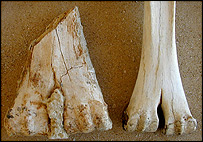 Archaeologists have discovered the 100,000-year-old fossilized remains of a previously unknown giant camel species in Syria. The bones of the dromedary were unearthed by a Swiss and Syrian team of researchers near the village of El Kowm in the central part of the country.
The animal is thought to have been double the size of a modern-day camel. It may even have been killed by humans, who were living at the once water-rich site during the same period. Jean-Marie Le Tensorer of the University of Basel commented:
"It was not known that the dromedary was present in the Middle East more than 10,000 years ago. The camel's shoulders stood three meters high and it was around four meters tall; as big as a giraffe or an elephant. Nobody knew that such a species had existed," he said.
Source [BBC]
Continue reading " Giant camel fossil found in Syria"
Posted at 02:19 PM in Features | Permalink | Comments (0) | TrackBack
October 03, 2006
Coming out in Arabic: Homosexuals in the MidEast
By Brian Whitaker
When Rauda Morcos heard there was an emailing list for lesbian Palestinians, she couldn't believe it at first. "I thought it was a joke," she said. "Until then, I thought I was the only lesbian who speaks Arabic." The list was certainly not a joke but, in a society where same-sex relations are still taboo, its members guarded their privacy. The only way a newcomer could join was by personal recommendation. "Eventually I got in," Ms Morcos recalled, "and I found a lot of other [lesbian] women who couldn't be out."
After corresponding by email for a few months, she thought it would be good to talk with some of the invisible women face to face, so, in January 2003, Ms Morcos and her flatmate called a meeting. "We had no expectations," she said, "but eight women turned up. The meeting lasted eight hours and I don't think anybody wanted to go home." That, it later turned out, marked the birth of Aswat ("Voices") - the first openly-functioning organisation for Arab lesbians in the Middle East.
Source: [Guardian]
Continue reading "Coming out in Arabic: Homosexuals in the MidEast "
Posted at 09:41 PM in Culture almighty, Features, Religion | Permalink | Comments (1) | TrackBack
August 21, 2006
Sugar in Amman
By Amal El Masri
As soon as Mama starts sugaring Auntie Lotfiyeh's legs, Zayna and I flee to the garden behind my house. Zayna hides under the pergola. She is giggling on her mobile and smoking a Gauloise. The grape vines stretch down from the grid and hide her with their green arms. I am playing hopscotch by myself on the concrete players that border our plum trees. The plums are crusty purple and oblong. They give me diarrhea, but Mama, who has chronic constipation, eats them by the kilo. She blames the constipation on my father, as she does everything else after he went to London, the dog son of a dog son of a dog who she prays will fall into the Thames.
From the kitchen window, we can hear the counterpoint of canvas strips torn from skin and Auntie Lotfiyeh's pain: Khwip. ACH! Khwip. AYE! Zayna cups the mouthpiece on her phone.
"Jude, it sounds like Abu Ghraib in there. I'm not letting your mom near me."
"It hurts your mom more because her thighs are fat. And you need to do your toes." Zayna throws me a "whatever" sign.
Source: [Toronto Star]
Continue reading "Sugar in Amman"
Posted at 01:11 AM in Entertainment, Features | Permalink | Comments (0) | TrackBack
July 31, 2006
What next, Lebanon?
 By Anthony Shadid
MUKHTARA, Lebanon - From his hilltop citadel, Walid Jumblatt was a worried man Saturday. In Lebanon's Byzantine, ever-shifting politics, the leader of the country's Druze community has emerged as one of Hezbollah's harshest critics. But a savvy veteran, he understood the arithmetic of the Middle East these days: In war, survival often means victory. And after 18 days of the conflict with Israel, he was bracing for what Hezbollah's survival would mean for a country seized with volatile uncertainty.
Lebanon's survival, he said, was now in the hands of Hezbollah and its leader, Hasan Nasrallah. "We have to acknowledge that they have defeated the Israelis. It's not a question of gaining one more village or losing one more village. They have defeated the Israelis," he said. "But the question now is to whom Nasrallah will offer this victory."
In contrast to the first days of the war, with ambitious U.S. and Israeli vows to dismantle the Lebanese group's militia, hardly anyone now expects Hezbollah to fade from a scene in which it has long played an intrinsic part, drawing support from a Shiite Muslim community that feels even more besieged today.
Source: [Washington Post]
Continue reading "What next, Lebanon?"
Posted at 11:37 PM in Features, War | Permalink | Comments (0) | TrackBack
July 25, 2006
In Beirut, an abyss between elegance and chaos
By Sabrina Tavernise
BEIRUT, Lebanon -- The Paul Restaurant is still serving elegant lunches of prosciutto and chèvre. At the Printania, an elegant hotel on a hill east of the capital, stylish guests sip Arabic coffee near a glass display case of éclairs and chilled chocolate mousse.
Some miles away, in the southern suburbs, the destruction from Israeli airstrikes is more earthquake than war zone. Streets have entirely disappeared. Rubble from bombed buildings in some areas is piled several stories high. City blocks, or what is left of them, are ghostly.
In the days since Israeli planes began to bomb Lebanon, this seaside capital has been almost physically split in two, with its largely Shiite flank mutilated by Israeli airstrikes and most of the rest of the city remaining relatively unscathed, if quieter and emptier than usual.
Source: [NY Times]
Continue reading "In Beirut, an abyss between elegance and chaos"
Posted at 11:07 AM in Features, War | Permalink | Comments (0) | TrackBack
July 01, 2006
Charades and an imaginary horseback ride in Jordan
 By Haley Edwards
I've become the best charades player in the world. Let me explain: If there's one thing I've learned traveling in Arabic-speaking countries, it's the ability to communicate rather successfully using only the delicate art of pantomiming. Picture me on a dusty street corner trying to find, oh, the train. I've exhausted my pidgin Arabic (cobbled together from dubiously phonetic transliterations in the back of my Lonely Planet travel guide) and I've thrown out as many synonyms for "train" as possible (on the off-chance that "locomotive" finds footing in the sparse list of Arabic-English cognates).
It's time to call out the big guns: Putting my backpack down, I begin shuffling, arms bent and pumping in a circular motion, elbows at my sides. I'm mumbling "chugga-chugga-chugga" -- interspersed, of course, with an overzealous "choo-choo!" -- while a sea of bewildered shopkeepers blink at the spectacle.
Source: [The Seattle Times]
Continue reading "Charades and an imaginary horseback ride in Jordan"
Posted at 01:12 PM in Features, Jordan in the news | Permalink | Comments (0) | TrackBack
June 21, 2006
Palestinian teen prefers life in an Israeli jail
By Mark MacKinnon
NABLUS, WEST BANK -- Mohammed Kharaz wanted to get away. He longed to escape the stretches of boredom broken by intense eruptions of violence that are a teenager's life in this strife-ridden city. So, for a break, he got himself thrown into an Israeli jail.
The idea wasn't even his, the 17-year-old confesses. He first heard it from a kid who sat beside him in class: If you get yourself arrested by the Israeli army, they send you to a prison with digital television, interesting books and even a decent soccer pitch. In short, everything you don't find in Nablus, a city cut off from the rest of the West Bank by a series of Israeli military checkpoints.
To Mohammed, it sounded like a dream vacation. So on Feb. 25, he tucked a kitchen knife under his shirt and headed toward the concrete barriers and metal turnstiles that block the road south to Ramallah. It played out just as his friend described. When he got to the front of the long, slow-moving line of Palestinians seeking to leave Nablus, an Israeli soldier told him to lift up his shirt. With a sniper's rifle pointed at his chest, Mohammed pulled out the knife.
Source: [Globe & Mail]
Continue reading "Palestinian teen prefers life in an Israeli jail"
Posted at 11:45 AM in Features, The Curious, War | Permalink | Comments (0) | TrackBack
June 20, 2006
The Taliban's new war on schoolgirls
By Ron Moreau and Sami Yousafzai
Summer vacation has only begun, but as far as 12-year-old Nooria is concerned, the best thing is knowing she has a school to go back to in the fall. She couldn't be sure the place would stay open four months ago, after the Taliban tried to burn it down. Late one February night, more than a dozen masked gunmen burst into the 10-room girls' school in Nooria's village, Mandrawar, about 100 miles east of Kabul.
They tied up and beat the night watchman, soaked the principal's office and the library with gasoline, set it on fire and escaped into the darkness. The townspeople, who doused the blaze before it could spread, later found written messages from the gunmen promising to cut off the nose and ears of any teacher or student who dared to return.
The threats didn't work. Within days, most of the school's 650 pupils were back to their studies. Classes were held under a grove of trees in the courtyard for several weeks, despite the winter chill, until repairs inside the one-story structure were complete. Nearby schools replaced at least some of the library's books. But the hate mail kept coming, with threats to shave the teachers' heads as well as mutilate their faces.
Source: [Newsweek]
Continue reading "The Taliban's new war on schoolgirls"
Posted at 05:31 PM in Extremism, Features, Religion | Permalink | Comments (2) | TrackBack
June 06, 2006
Is Qatar the Next Dubai?
 By Seth Sherwood
FIVE times a day, the Muslim call to prayer echoes through the mazelike passageways of Souk Waqif in Doha, the capital of Qatar. Projected from slender minarets that dot Doha, a low-lying white city along the Persian Gulf, the warbling, ages-old Arabic incantation reverberates through stalls selling everything from traditional khanjar daggers to baby strollers. When it arrives, merchants in long, white gutras and checkered headdresses kneel toward Mecca and pray.
Lately, however, the call to prayer has been competing with a much more modern sound, one that heralds a bold new direction for this languid city of 400,000: the sound of construction. Lots of it.
According to the Qatar Tourism Authority, more than 100 buildings and towers are going up in Doha, whose modest skyline is currently punctuated by about two dozen high-rises. Cranes fill the hot sky. Skeletal hotels, resorts and financial centers ring Doha Bay. And from every corner, a symphony of earth-moving equipment and power tools hums the theme of one of the world's richest countries (as measured by gross domestic product per capita) striving to become a world-class business and leisure center.
Source: [New York Times]
Continue reading "Is Qatar the Next Dubai?"
Posted at 11:52 PM in Development, Features | Permalink | Comments (1) | TrackBack
May 17, 2006
Gay & Lesbian Arabs: Inside the 'Double Closet'
By Sarah Klein
The suffocatingly sweet scent of peach-flavored tobacco wafts through the Male Box, swirling around the disco lights that ricochet off mirrored walls. The aroma is rising from a series of hookah pipes perched on glitter-flecked tables -- a rather odd juxtaposition in a beer-and-shot gay bar that's located on a desolate stretch of Seven Mile Road in Detroit.
It's Saturday night and the place is slowly filling up with men of a variety of ages and races -- but this isn't any ordinary evening. Tonight, the bar is playing host to Arabian Nights, a series of monthly events designed to validate and unite one of the most closeted communities in the area, and in the nation: Gay and lesbian Arabs. Arabian Nights is orchestrated by AL-GAMEA, a group formed in 2004 by three gay Arab men dedicated to creating a forum for support, socialization, education and awareness, in an area that's home to the largest and most visible Arab-American community in the country.
Christiano Ayoub Ramazzotti, 31, is a small man with big aspirations. The full-time HIV counselor and former high school gymnastics coach zips through the bar, hugging friends, shaking hands, making introductions. Bashar Makhay, 21, mans the DJ booth; as cultures collide and mesh, so does the music -- traditional Arabic rhythms are layered over staccato electronic beats common in dance clubs.
Source: [AlterNet]
Continue reading "Gay & Lesbian Arabs: Inside the 'Double Closet'"
Posted at 08:21 AM in Culture almighty, Features | Permalink | Comments (1) | TrackBack
May 13, 2006
Resourceful Palestinians turn to each other to get by
By Scott Wilson
BEIT IKSA, West Bank -- At the end of last month, a crowd gathered in the town hall here to take part in an unusual act. About 75 people, all employees of the Palestinian Authority, were getting paid. Like the rest of the 150,000 Palestinian civil servants, the teachers, bureaucrats and policemen here had not received a paycheck for nearly two months, the result of a freeze in international aid following Hamas's victory in January legislative elections.
But this village has a patron, a native son who prospered in the United Arab Emirates. Although he has returned to his birthplace only a handful of times since leaving with his family following the 1967 Middle East war, over the years Zuhair Jubran has remembered his village in trying times, few more so than now. With the government unable to make payroll, Jubran decided he would. Each public employee, including teachers from neighboring villages who work in Beit Iksa's boys and girls schools, has started receiving a monthly salary of $325 from Jubran's private accounts.
As their government withers without international aid, Palestinians are tailoring modest lives to desperate times. Bartering, borrowing and doing without, thousands of people in the West Bank and the Gaza Strip are improvising their way through a deepening financial crisis with help from native sons, virtual strangers and each other.
Source: [Washington Post]
Continue reading "Resourceful Palestinians turn to each other to get by"
Posted at 05:00 PM in Developing story, Features | Permalink | Comments (0) | TrackBack
May 01, 2006
A booming Dubai offers promise and disillusion
 By Anthony Shadid
DUBAI, UAE -- There aren't a lot of qualifiers in Ahmad Sharaf's vocabulary. Like his city, he prefers superlatives. As he accelerated his 1995 white Porsche 911 down a grand boulevard landscaped with palm trees and periwinkles, Sharaf, the senior executive of a government corporation, looked out at a city-state that is building the world's tallest skyscraper, largest shopping mall, most luxurious hotel, largest man-made marina and biggest artificial island.
Out the left of his car was the Persian Gulf, its turquoise waters bordering a region booming by virtue of the highest oil prices in history. To the right was forbidding desert stretching into Saudi Arabia and the tumult of the rest of the Arab world.
"The only limitations are your own limitations," he said matter of factly. "No one tells you that it cannot be done, that it should not be done. The only pushback has always been let's do it bigger, let's do it better, and let's do it smarter."
Source: [Washington Post]
Continue reading "A booming Dubai offers promise and disillusion"
Posted at 10:53 PM in Development, Features | Permalink | Comments (1) | TrackBack
April 21, 2006
Three faiths seek understanding through adventure
By Kathryn Williams
As a captain for the New York City Fire Department, Dan Sheridan is used to bonding under stressful, often dangerous circumstances. He's accustomed to living day in and day out with people he may not have much in common with except the task at hand. But the last time Sheridan, 44, drove a fire truck was while crossing the Sahara Desert as part of a multicultural peacebuilding expedition. The team -- two Americans, two Israelis, an Iraqi, an Iranian-American, a Palestinian, a Ukrainian and an Afghan -- was a motley crew whose goal was simply to get along.
Sheridan is exactly the kind of American that Heskel Nathaniel, co-founder of Breaking the Ice, the Berlin-based group that sponsored the trip, was looking for. In fact, Nathaniel actively sought him out. In 2004, Nathaniel led a group of four Israelis and four Palestinians, strangers and novice climbers, on a history-making trip to a never-before climbed mountain in Antarctica. After some infighting, the team named it "The Mountain of Israeli-Palestinian Friendship." For the organization's second expedition, Nathaniel widened his sights to the clash between Islam and the West. The team would trek from Jerusalem, across the Sahara Desert, to Tripoli -- a final destination the group never reached.
Ominously, the group faced conflict the first time it met, for training in the Jordanian desert.
Source: [Newsweek]
Continue reading "Three faiths seek understanding through adventure"
Posted at 12:33 AM in Features, Jordan in the news, Religion | Permalink | Comments (0) | TrackBack
December 14, 2005
Arab nations plagued by reckless driving
DUBAI, United Arab Emirates (AP) -- On urban highways in the Middle East, cars pinball across lanes at over 100 mph, and wrecks are so gory and damage so great one might think the mangled vehicles were destroyed by a bomb. The region is plagued by some of the world's highest accident rates, with reckless drivers and speeders blamed for some 3,000 traffic deaths per month in Arab nations.
The carnage has emerged as a public health crisis -- the second-leading cause of death, after heart disease, in wealthy Persian Gulf countries -- and a chief cause of gridlock gripping many of the Middle East's fast-growing cities. World Health Organization statistics show the "Eastern Mediterranean region" -- including most Arab countries, Israel, Iran, Pakistan and Afghanistan -- has a rate of 26.3 deaths from traffic accidents per 100,000 population. Only Africa's rate is higher, at 28.3. In North and South America, the rate is 15.7; the rate in Europe is 14.5.
In Arab nations, it amounts to 3,000 deaths a month, according to a study by the Tunis-based Arab Road Safety Organization. "That's equivalent to the number of Sept. 11 victims," Riadh Dabbou, chief of the organization, told the Gulf Traffic Convention in Dubai Monday. Gulf nations are the worst offenders in the Arab world.
Source: [Yahoo News]
Continue reading "Arab nations plagued by reckless driving "
Posted at 12:50 PM in Features | Permalink | Comments (1) | TrackBack
October 29, 2005
'We don't need al-Qaida'
Abu Theeb is a tall, handsome, well-built man with a thin beard and thick eyebrows. His name is a nom de guerre: it means Father of the Wolf. He is a farmer during daylight and a commander of a mujahideen cell, a group of holy warriors, at night. He and his men roam the farmland north of Baghdad in search of prey - a US armoured Humvee, perhaps, or an Iraqi army unit.
On the eve of last week's constitutional referendum, Abu Theeb, the leader of a group of Sunni insurgents, was to be found in the middle of a schoolyard in a village north of Baghdad. The school was to be a polling centre the next day. He stood flanked by 10 bearded fighters in white robes and chequered headscarves.
There were a few posters on the walls, and plastic ribbons marking out lanes where voters would queue, but other than Abu Theeb and his men, the building was deserted. The security guards hired by the referendum committee in Baghdad had failed to show up - not all that surprising an event in one of the most dangerous areas in Iraq. The local tribe, ie Abu Theeb and co, are notorious for kidnappings and executions.
Source: [The Guardian]
Continue reading "'We don't need al-Qaida'"
Posted at 04:45 PM in Extremism, Features, War | Permalink | Comments (0) | TrackBack
October 26, 2005
A mosaic of Arab culture at home in America
By Edward Rothstein
DEARBORN, Mich. -- At the heart of the nation's first museum devoted to the history of Arab-Americans is a mosaic-decorated courtyard surrounding a small fountain, evoking the traditional courtyard of Arab lands. A symbol of hospitality, it is also, typically, a feature of one's home, and this museum is, in its way, a declaration that Arab-Americans really are at home, not just in Dearborn (where some 30% of the 100,000 residents call themselves Arab-Americans) but in the US itself.
The surest sign of that may be that, like other groups, they have built this museum honoring their past and their identity. And the 38,500-square-foot, $16 million Arab American National Museum, which opened in May, is, like other museums of American hyphenation, at once an assertion of difference and of belonging, a declaration of distinction and of loyalty. It would be making a political statement even if it weren't directly across the street from City Hall.
The museum was also designed to reflect the interests of its constituency: Arab-Americans. That is a source of its strengths, and suggestive too of its weaknesses: it eagerly wants to celebrate that identity and create a strong political front; it is less interested in reflecting on difficulties and making distinctions.
Source: [NY Times]
Continue reading "A mosaic of Arab culture at home in America"
Posted at 05:55 PM in Culture almighty, Features | Permalink | Comments (0) | TrackBack
October 04, 2005
The two ladies from Egypt
Two remarkable ladies demonstrate the endless possibilities Americans enjoy. Ms. Dina Onsi Habib Powell is the White House personnel director, who was appointed recently by President Bush to hold the position of Deputy Under Secretary of State for Public Diplomacy, and Assistant Secretary of State for Educational and Cultural Affairs. Ms. Laila Ali Hussein is a captain in the United States Navy.
Ms. Powell and Ms. Hussein have a few traits in common: they are young, attractive, brilliant, and both are Egyptian American. Their success stories are meaningful and particularly relevant to Arabs like me for several reasons, the first being their gender. There is no need to elaborate on that issue as we are all painfully aware of the status of women in our Arab societies.
The fact that they have achieved such a level of success at such a young age is a second reason, reminding us of the predicament of millions of young Arabs who can only day-dream about such achievements, while their peers in open societies have access to the highest positions, unhindered by age constrictions. A third reason would be that they both speak Arabic fluently, and are proud of their Arab origin and heritage.
Source: [The American Thinker]
Continue reading "The two ladies from Egypt"
Posted at 05:00 AM in Features | Permalink | Comments (1) | TrackBack
July 25, 2005
Terrorists remind the world: It can happen anywhere
By Michael Hirsh, Mark Hosenball and Kevin Peraino
Jitendra Patel, a 40-year-old software developer from London, was enjoying an "absolutely brilliant" time last week with his family in Sharm al-Sheikh, a posh beach resort on the Red Sea. Patel's 7-year-old daughter, Manisha, had just finished school in the United Kingdom, and Patel needed a break, too. He had been one of those on the London Underground on July 7, making his way to work at Merrill Lynch, when the first group of bombers hit. Like thousands of other passengers, the "cheesed off" Patel had been forced to evacuate and take to the streets.
But late Friday night Patel learned just how small the world has become. Shortly after he returned to his room at the five-star Movenpick Hotel on Sharm al-Sheikh's main boulevard, his wife, Kashmira, glimpsed a split-second flash of light through the window. Then she heard a roar. The bone-jarring force of the explosion knocked loose the doorknob of the Patels' room.
Across the street they saw that a car bomb had sheared away the face of the Ghazala Gardens Hotel, turning its lobby into a pile of rubble. At least 88 people died in that and two other coordinated blasts that night. Patel, who was back at the Movenpick pool sunning himself the next day, seems resigned to the new facts of global terror in the 21st century: "We can't keep running away. It's life." Kashmira Patel, on the other hand, has nothing like her husband's aplomb. "I'm frightened for everyone," she says. "It can happen to anyone, anywhere."
Source: [Newsweek]
Continue reading "Terrorists remind the world: It can happen anywhere"
Posted at 01:00 AM in Features, Terrorism | Permalink | Comments (0) | TrackBack
July 24, 2005
Eyewitnesses detail Sharm el Sheikh carnage
SHARM EL-SHEIKH, Egypt (Washington Post) -- It was a little after 1 a.m. when the sweltering summer day finally gave way to a breezy desert night, and the merchants of Egypt's premier Red Sea resort wrapped up business and headed for festive, 24-hour cafes.
Nasser Ali gathered the receipts at his tourist shop, Layali al-Hilmiya. Mohammed Eissa straightened the shelves in his stationery store. Sayyid Sayyid, cheerfully speaking broken English, finished cutting the hair of his last customer at Friends Coiffure. In the 15 minutes that followed early Saturday, Sharm el-Sheikh, always a little more freewheeling and relaxed than the rest of Egypt, was transformed into an arcade of destruction as arbitrary as it was devastating.
With three bombings, carefully coordinated under the cover of night, dozens of people were killed, many more were wounded, and businesses were wrecked. In the wake of grief, a city blessed by azure waters, some of the world's best coral reefs and the generosity of tourists, fell silent. It began across the street from Ali, Eissa and Sayyid's workplaces.
Source: [MSNBC]
Continue reading "Eyewitnesses detail Sharm el Sheikh carnage"
Posted at 07:00 PM in Disturbing report, Features, Terrorism | Permalink | Comments (0) | TrackBack
July 11, 2005
The Enigma of Damascus
 By James Bennet
The opera house in Damascus was a long time coming. Hafez al-Assad, the iron-willed military man who ruled Syria for three decades, was in power just a few years when he laid the cornerstone. But lack of materials and equipment, hard economic times and a devastating fire delayed the project year after year. It fell to Assad's son and successor, Bashar, to finish the job.
He opened Al Assad opera house with his wife, Asma, last year. Decorated with paintings and sculptures by Syrian artists, offering up classical concerts and works by Arab playwrights, the building expresses something of the elder Assad's vision of Damascus as the Arab capital of cultural, if not political, enlightenment. The name of his controlling party, Baath, means resurrection, and nothing could better reflect an Arab renaissance than achievement in the arts.
For a dance performance one evening last month, a mixed crowd streamed through the doors. Women with showy hairstyles mingled with others in head scarves; men came in suits or jeans. One teenage boy wore a T-shirt that admonished in English, ''Your game is still as ugly as your girl.'' As curtain time approached, Syria's power couple walked in.
Source: [NY Times]
Continue reading "The Enigma of Damascus"
Posted at 05:45 PM in Development, Features, Politics | Permalink | Comments (0) | TrackBack
June 04, 2005
'8 long, horrible hours' safeguarding an Iraqi bridge
Anna Badkhen
Samarra, Iraq -- At 2 p.m., Spc. Mike Rauch points his tank's massive, 120mm gun at the northeastern tip of the Southern Bypass Bridge that spans the dusty marshland outside Samarra. Another day of highway patrol, Iraq-style, has begun.
Rauch's job, and that of his two crew members aboard the 70-ton M1A Abrams, is to protect the bridge on the outskirts of this Sunni town, a key link on the main route for civilian and U.S. military traffic from the southern port city of Basra to the border with Turkey in the north.
Every day, from 2 in the afternoon until 10 at night, Sgt. Saikichi Simram, the tank's commander, Pvt. Andrew Queen, the driver, and gunner Rauch, from Mariposa in Central California, watch this stretch of road for what have become the two deadliest threats to Iraqi civilians and the 138,000 American soldiers who are supposed to help protect them: cars that look like they might be driven by suicide bombers and insurgents trying to plant roadside bombs.
Source: [San Francisco Chronicle]
Continue reading "'8 long, horrible hours' safeguarding an Iraqi bridge"
Posted at 09:30 PM in Features, War | Permalink | Comments (0) | TrackBack
May 10, 2005
Faith trumps ethnicity for Detroit metro Arabs
By Niraj Warikoo
At the Islamic Center of America in Detroit, Adam Karaali, 8, of Dearborn watches Ali al-Najjar, 11, of Dearborn read the Koran in preparation for a play Friday. The opening of the new museum in Dearborn should raise the profile of Arab Americans, some say.
Inside a Detroit mosque Friday night, gaggles of teens shuffled into the main hall for soda and cake to celebrate the birthday of the prophet Muhammad. Most were U.S.-raised and of Arab descent; the Islamic headscarves on some women meshed comfortably with baggy football jerseys. They are, in many ways, the future of Arab America. But when asked how they primarily see themselves, most reply: Muslim or Muslim American.
"Islam is a priority for me," said Ali Fawaz, a 23-year-old Dearborn resident of Lebanese descent who helped organize the gathering at the Islamic Center of America. "It comes before my ethnicity. Islam unites me with people of different races, nationalities, different cultures."
Source: [Detroit Free Press]
Continue reading "Faith trumps ethnicity for Detroit metro Arabs"
Posted at 01:45 PM in Culture almighty, Features, Religion | Permalink | Comments (0) | TrackBack
May 04, 2005
6 miles to the airport: The toughest commute in Iraq
By Jill Carroll and Dan murphy
BAGHDAD - Samson has been delivering supplies to US military bases for a year. It's a good business that sends him to Baghdad International Airport daily. He reads Psalm 91 before every trip. Samson, a native of Madras, India, pulls out his dog-eared, hardbound Bible and reads his favorite verse. "A thousand shall fall at thy side, and ten thousand at thy right hand; but it shall not come nigh thee."
He prays because the four-lane, six-mile stretch of road leading from central Baghdad to the country's main airport remains one of the most dangerous stretches of highway in Iraq, if not the world. It functions as a critical supply line into and out of the country, traversed daily by US military convoys as well as Iraqi and foreign businessmen, journalists, and aid workers.
So why is this vital strip of concrete, which takes only minutes to travel, still so difficult to protect? One answer is that despite numerous US military checkpoints, the insurgents know that this is a "target rich" route that is the heart of military and contractor supply routes, and they continue to challenge every security measure devised.
Source: [CSM]
Continue reading "6 miles to the airport: The toughest commute in Iraq"
Posted at 05:00 AM in Features, Jill Carroll, War | Permalink | Comments (0) | TrackBack
May 02, 2005
Why a black market for gasoline vexes Iraq
By Jill Carroll
BAGHDAD -- Salam Hassan and Jabbar Kadhim's oil- and gas-delivery company helps keep the lights on and equipment churning at a number of Iraq's hotels and businesses. But when fuel shortages hit recently, the two men had to scramble to satisfy their customers. So they dipped into the black market.
"We have to deal with a lot of hotels and companies that depend on us. So if I am late, they will go with someone else," Mr. Hassan says.
Iraq sits on one of the world's largest oil reserves, producing 2.3 million barrels a day. But its aging refineries have struggled to keep up with growing demand, fueled in large part 1.5 million new cars on the roads and an influx of home appliances. Add to this Hussein-era subsidies that keep prices artificially low, continuing insurgent attacks on pipelines, and corruption, and the shortages are creating an underground market that the new government is struggling to control.
Source: [CSM]
Continue reading "Why a black market for gasoline vexes Iraq"
Posted at 09:30 AM in Development, Features, Jill Carroll, War | Permalink | Comments (0) | TrackBack
April 26, 2005
Peruvian woman rejects $1.5m to sell virginity
 By Hannah Hennessy
Lima -- Inside a tiny breeze block house, beneath the dusty hills on the desert outskirts of Lima, religious paintings like the Virgin and Child and the Sacred Heart share wall space with photographs of a beguiling young woman posing as a model. The Bible is open at John, Chapter 11, telling the story of the Resurrection of Lazarus.
Behind the curtains which separate a tiny bedroom from the living room, lies a sick 43-year-old woman, whose daughter, Graciela, is prepared to take drastic measures to help her. Graciela -- or Gracia as she prefers to be known -- has been working since the age of eight, left school at 15 and now three years later earns around $60 a month acting or modelling. Her mother is too sick to work and she does not want her 12-year-old brother to miss school.
But Gracia says the money she earns is not enough and every month she worries about not being able to pay the bills or having to say No when her brother Guillermo comes back from school asking for money for books. Theirs is a story like thousands of other Peruvians who live in poverty, but for one fact. Last month, Gracia decided to sell her virginity to pay for her mother's medical treatment and to improve her family's quality of life.
Source: [BBC]
Continue reading "Peruvian woman rejects $1.5m to sell virginity"
Posted at 12:39 PM in Culture almighty, Features, Religion | Permalink | Comments (3) | TrackBack
April 22, 2005
Iraq's rising industry: domestic kidnapping
By Jill Carroll
BAGHDAD -- Abu Mohammed was chatting with a friend in an auto repair shop in Salman Pak two months ago when masked gunmen surrounded him and stuffed his 260-pound frame in their trunk and sped away. He spent the next 10 days locked in a bathroom with a hood over his head, marking the passage of time by listening to his captors' prayers.
A wealthy businessman who traveled daily from Baghdad to Salman Pak for more than 20 years, Mr. Mohammed survived after paying $60,000 to the kidnappers that he says were extremist Sunnis. "When I asked for a cigarette they said 'why do you want a cigarette?' It's haram," he says, using the Arabic word for something forbidden by Islam.
Mohammed and local residents say a raft of insurgents have flooded the Salman Pak area, located about 18 miles south of Baghdad and inside the Sunni stronghold known as the "Triangle of Death," since January, just over a month after the US Marine siege on Fallujah sent insurgents scattering to find new havens. In Salman Pak the result is a spate of violence and kidnappings that are stoking ethnic tensions.
Source: [CSM]
Continue reading "Iraq's rising industry: domestic kidnapping"
Posted at 09:30 AM in Features, Jill Carroll, Terrorism, War | Permalink | Comments (0) | TrackBack
April 20, 2005
Ordinary Iraqis bear brunt of war
By Jill Carroll
BAGHDAD -- Little Zeinab Yasseen was still asleep as the third Ramadan of her young life dawned. Like every night, she had drifted off listening to the chatter of the 26 relatives who also shared the house in Baghdad's poor Al Shaab neighborhood.
She awoke to her home collapsing on her. A car bomb exploded in front of the police station down the street, but it brought the roof down on Yasseen and her family. Somehow, everyone survived. But 17 months later, Zeinab still can't move her legs. And the family is still recovering - emotionally, financially, and physically - from that instant of devastation.
Each explosion of this kind deepens Iraqis' doubts about the US and Iraqi government's ability to bring order. But whatever each attack costs the this government in credibility, it is ordinary Iraqis who pay the highest price. Thursday's bombings in Baghdad brought more of the same.
Source: [CSM]
Continue reading "Ordinary Iraqis bear brunt of war"
Posted at 05:15 AM in Features, Jill Carroll, War | Permalink | Comments (0) | TrackBack
April 18, 2005
Terrorism tempers Mideast reforms
Tough security measures collide with push toward openness
By Craig Whitlock and Steve Coll
RABAT, Morocco - They have testified in community centers, schoolhouses and municipal halls, and on live television. They have been withered mothers, grieving grandchildren, scarred old men -- a diverse parade of ordinary Moroccans bound by a common experience of political terror. This year, they have become players in a national spectacle almost unheard of in the Arab world: an official investigation into past government abuses.
"My story is that of thousands of Moroccans," said Jamal Ameziane, 52, who testified that 30 members of his family were harassed or tortured after his father was forced to flee the country in the late 1950s. "I dream of lifting the veil on the dark years."
Source: [MSNBC]
Continue reading "Terrorism tempers Mideast reforms"
Posted at 10:31 AM in Features, La Revolutione, Terrorism | Permalink | Comments (0) | TrackBack
April 16, 2005
Iran eases its social strictures
 By Scott Peterson
TEHRAN, IRAN -- Stuck in traffic, the young driver with goatee, shades, and a roving eye spots his targets -- two lanes over. Oozing self-confidence, he rolls down his window and motions to the passenger in the next car to roll down both his windows, so he can deliver his pickup line directly. The women, coiffed in head scarves, peered across at their suitor. Unmoved, they drive on.
"Oh well, I guess they weren't interested," laments Siavash, ending another attempt at a secret liaison in Iran, where official limits on male-female contact have turned even traffic lanes into passion-laced zones.
Siavash is a college graduate who spends his days fulfilling his military duty. But after hours, he takes full advantage of an unexpected softening of social strictures in the Islamic state -- describing quiet streets where young men "park" cars with girlfriends and parties where drugs and alcohol are increasingly common. Social freedoms have long been a barometer of politics in Iran, and pundits predicted that conservatives would crack down when they regained control of parliament in February 2004.
Source: [Christian Science Monitor]
Continue reading "Iran eases its social strictures"
Posted at 01:30 PM in Culture almighty, Features, Religion | Permalink | Comments (0) | TrackBack
Jordanian City of Salt Draws Fire Over Radicals
By Shafika Mattar
SALT, Jordan (AP) -- This city -- with its numerous churches, its liquor stores, and its past as a cosmopolitan trading hub -- was an unusual one to suddenly develop a reputation as a center of Islamic radicals traveling from Jordan to fight in Iraq. Jordanian officials say it's undeserved, the result of a series of misunderstandings. In fact, they say, the city is home to only a small handful of the Jordanians known to have joined the insurgency in Iraq.
Nevertheless, all sides acknowledge the city of Salt has its share of disaffected Muslim youths dismayed by economic problems, angry at foreign troops on Muslim lands and vulnerable to messages of extremism. It was the city's custom of holding public wakes that brought publicity here. Specifically, it was the wake for a native son, Raed Mansour al-Banna, who was accused of carrying out the biggest suicide bombing in postwar Iraq -- an attack on Feb. 28 in Hilla, south of Baghdad, that killed 125 people.
Source: [Guardian]
Continue reading "Jordanian City of Salt Draws Fire Over Radicals"
Posted at 11:00 AM in Extremism, Features | Permalink | Comments (0) | TrackBack
March 26, 2005
A Jordanian's journey to the top of the world
By Ali Al Khalil [originally published January 2004]
AMMAN -- "When there is a will, there is a way," is how the saying goes. But when it comes to Jordanian Mustafa Salameh and his will, there is only one way possible: Through a path that after a 12-month journey is set to take him over the highest summit of Mount Everest in the Himalayas. A feat that - if achieved - will make the 33-year-old the first Arab to reach the topmost point on earth.
"The idea first crossed my mind during a visit to India in 2001. But when I found out that no Arab has done it before, I decided that I'm definitely doing it," Salameh told The Star. Edinburgh resident, Salameh is no stranger to adventure. The certified scuba diver - with more than 50 open-water dives - is also an avid hiker, whose visit to India in 2001 was part of an exploration that lasted for six months and also took him to Nepal, Tibet and China; visiting such mesmerizing places like Kashmir, Leh and the 6,700m-above-sea-level lake of Chandartal.
Unfortunately for Salameh, he will miss the March 2004 expedition that is heading to Everest, located in Nepal, due to his higher than required heartbeat, which currently stands at 69 beats per minute; while to climb to the top of the 8,850m above sea level mountain he needs to bring down his heartbeat to 55bps, which can be achieved through training.
Source: [The Star]
Continue reading "A Jordanian's journey to the top of the world "
Posted at 08:15 AM in Features | Permalink | Comments (0) | TrackBack
March 20, 2005
For Arab Writers, New Lines in the Sand
Young Authors Push the Limits of Social and Political FreedomBy Scott Wilson
RIYADH, Saudi Arabia -- Each day she sits alone, scribbling thoughts on scraps of paper. She stuffs them in a bottle given to her years earlier by her grandmother, who said it should serve as a place for private feelings that Arab society would not tolerate from a woman if uttered aloud.
The bottle fills, the woman ages. The life it holds on a million pieces of paper remains undiscovered, stifled and secret.
The story is the work of Yousef Mohaimeed, a Saudi author, who, like many in a new generation of rising fiction writers here, is taking on some of the most divisive subjects in the Arab world. The work is drawing attention, here and abroad.
Two months ago, a group of men entered a bookstore on one of the capital's broad avenues, lined with designer boutiques and glass-and-steel shopping malls. They seized copies of "The Bottle," which includes an unflattering portrayal of an Islamic militant, after it had sold 500 copies in just three days, a feverish pace in the kingdom. Although the government had approved the book for sale, the men warned the shop not to carry it again.
Source: [Washington Post]
Continue reading "For Arab Writers, New Lines in the Sand"
Posted at 12:41 AM in Culture almighty, Entertainment, Features | Permalink | Comments (0) | TrackBack
March 19, 2005
Syria's Leader Moves to Consolidate His Power
By Hassan M. Fattah
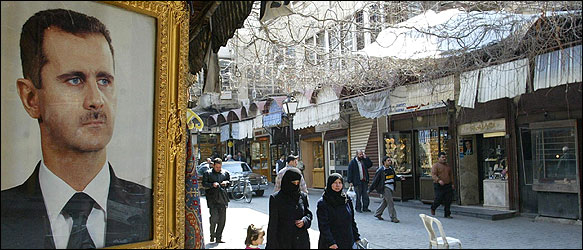
DAMASCUS, Syria -- When Bashar al-Assad inherited the presidency of Syria from his father five years ago, there was talk of a new era. An ophthalmologist trained in England, the soft-spoken young Assad favored economic reform and openness to dissent. He shunned the personality cult of Arab dictators, declining to paper the country with his image.
Last week, though, his picture was on every street corner as Damascus held a well-orchestrated rally celebrating his rule.
The posters are the most visible and recent sign that Mr. Assad, 39, has shifted tactics, starting a campaign to consolidate power and shore up his position in the midst of the international crisis over Syria's three-decade domination of Lebanon.
"Bashar is learning that his father did things for a reason," says Joshua Landis of the University of Oklahoma and the Web site Syriacomment.com, who is spending 2005 in Damascus. "If you're going to be a dictator you're going to have to act like one."
Source: [NY Times]
Continue reading "Syria's Leader Moves to Consolidate His Power"
Posted at 05:15 PM in Features, Politics | Permalink | Comments (0) | TrackBack
March 18, 2005
Patchwork of progress and perils in Iraq
By Jill Carroll
BAGHDAD - Last week, Diyala Province felt the benefit of American reconstruction money: two farm cooperatives got under way, providing a much-needed source of income for several families in the often violent province.
This week, the area felt the sting of the insurgency: A suicide bomber drove into an Iraqi Army checkpoint, killing several soldiers.
Two years after US forces rolled into Iraq to depose Saddam Hussein, contradictory forces are tugging at the war-torn country. Iraqis turned out in droves to vote for an 275-member assembly that took its seats Wednesday. Many are enthusiastically tapping into a world long closed to them by sanctions - snapping up satellite TV dishes and imported food.
But an aggressive insurgency has stymied crucial tasks of rebuilding and providing security, disillusioning ordinary Iraqis who thought the US presence would bring rapid change.
Source: [CS Monitor]
Continue reading "Patchwork of progress and perils in Iraq"
Posted at 10:45 AM in Features, Jill Carroll, War | Permalink | Comments (0) | TrackBack
March 10, 2005
Iraqi Influx Drives Jordan's Post-War Boom
By Suleiman al-Khalidi
AMMAN, Jordan (Reuters) - Iraqi businessman Talal al-Gaaod looks out from his glass fronted office over the hills of Amman and reflects on the chaos in his homeland that has helped Jordan thrive as a safe haven for thousands of his countrymen.
And their money.
An estimated 50,000 families from Iraq (news - web sites) are just the latest human wave to enter Jordan. This is a country whose destiny has been shaped by successive inflows of people from around the Middle East since it was founded in 1921.
"Capital is a coward in search for security. In Iraq mobs are after anybody who can afford a ransom," Gaaod said, sitting in a new five-story office building in the affluent Shemeisani neighborhood, the base of his Tabouk Group, a real estate and financial investment business.
Jordan established itself as a gateway and supply route for Iraq during two war-scarred decades prior to the 2003 U.S.-led invasion. The latest wave of wealthy Iraqis has brought an extra $2 billion into Jordan, bankers say, driving a boom not seen since the 1991 Gulf War (news - web sites) when hundreds of thousands of Palestinians fled Kuwait for sanctuary.
Source: [Yahoo News]
Continue reading "Iraqi Influx Drives Jordan's Post-War Boom"
Posted at 02:15 PM in Features, Politics, War | Permalink | Comments (0) | TrackBack
March 05, 2005
Loosening their religion
 Sick of silence, Muslim women are shaking up the boys' club
By Jordan Lite
Asra Nomani's stomach was churning as she passed through the front door of her mosque and stepped into its glittering, cavernous sanctuary. Her prayer there would not be merely religious; Nomani, 39, was making a bold act of disobedience. Women were supposed to take a wooden side door into the building and pray upstairs, away from the mosque's main hall and male worshipers.
When the mosque's president begged her to retreat to the women's balcony, she was resolute. "Thank you, brother," she told him. "I'm happy praying here."
Nomani's outspokenness is unusual, but it is part of the distinctly female voice defining a controversial movement for reform in the Islamic world. Wounded by public criticism and policies that singled them out after the Sept. 11 terrorist attacks, many Muslims in the United States closed ranks and became tight-lipped.
But the scrutiny of Islam also brought new attention to brutal practices against women abroad in the name of the religion, from lack of education to limited rights to initiate divorce and retain custody of children. Emboldened by the sudden public interest in these problems, and free in the United States to speak their minds without fear of the government reprisal that exists in many of their homelands, Muslim women have taken the lead in challenging the status quo.
Source: [NY Daily News]
Continue reading "Loosening their religion"
Posted at 05:44 AM in Features, Religion | Permalink | Comments (0) | TrackBack
February 07, 2005
The rise of the 'Muslim Boys'
By David Cohen
Winston emerges menacingly from the kitchen, a meat cleaver in one hand and a kitchen knife with an eight-inch blade in the other. "I love knives," he says, his eyes gleaming as he begins to slash the air inches from my face.
"Guns make a f***ing noise, but knives go in," he pauses, "silentlike, easy." He begins stabbing the wall and hacking the plaster, and then, just as suddenly, stops, seemingly sated, like an addict who has had his fix.
He holds up his blades to inspect them. "F***ing quality," he says, and deposits them unceremoniously his trousers. Winston, 21, black and from south London, licks his teeth as he paces around the stripped-bare flat on a Peckham estate that serves as one of his gang's many secret hideouts. He speaks in his gang's uniquely coded lingo.
"Knives is f***-all. Later, my bruvs will be back from their robberies with our skengelengs [guns] and cream [money]. Later there be MACinside-10s [sub-machine guns] all over the floor, laid wall to wall. And moolah! We count it - 10 grand, 20 grand. Then, after midnight," he adds, matter-of-factly, "me and my bruvs go to mosque to pray."
Source: [Evening Standard]
Continue reading "The rise of the 'Muslim Boys'"
Posted at 09:53 AM in Features, Religion, The Curious | Permalink | Comments (16) | TrackBack
February 05, 2005
Young, Palestinian and Proud
By Dina Shiloh
I called Tamer Nafar, Israel's best-known Arab- Israeli rapper, after hearing some of his music on the radio. Intrigued by his bold lyrics about drug abuse, unemployment and the conflict between being an Arab and being an Israeli, I asked for an interview. ‘You are welcome any time,' said Nafar in rapid-fire Hebrew. ‘But I'm not coming to Tel Aviv – I don't have the money for the bus. You'll have to come to Lod. You'll see what it's like here, the most neglected town in Israel.'
Not many visitors to Israel go to Lod, although it's just a few miles east of the airport. During the British Mandate it was an important town, near the airstrip at Lydda and the main railway terminal. Before the Brits, the Greeks, Romans, Crusaders and Ottomans all visited Lod and left their architectural mark.
Now the Brits, and the rest, have long gone, the airport is called ‘Ben Gurion', the British cemetery is forgotten, and Lod has fallen out of favour. ‘Half the population here is Arab and so the town is completely neglected. There are no jobs here, people turn to drugs and crime, and now it's become the centre of criminal activity in the country,' charges Tamer Nafar on the phone.
Source: [Jewish Quarterly]
Continue reading "Young, Palestinian and Proud"
Posted at 01:00 PM in Culture almighty, Features, War | Permalink | Comments (0) | TrackBack
Iraqi Police Use Kidnap Videos to Fight Crime
 By Christine Hauser
MOSUL, Iraq - In one scene, the videotape shows three kidnappers with guns and a knife, preparing to behead a helpless man who is gagged and kneeling at their feet. In the next, it is one of the kidnappers who is in detention, his eyes wide with fear, his lips trembling, as he speaks to his interrogators.
"How do I say this?" says the kidnapper, identified as an Egyptian named Abdel-Qadir Mahmoud, holding back tears. "I am sorry for everything I have done."
In the first week after the elections, the Iraqi Interior Ministry and the Mosul police chief are turning the tables on the insurgency here in the north by using a tactic - videotaped messages - that the insurgents have used time and again as they have terrorized the region with kidnappings and executions.
But this time the videos, which are being broadcast on a local station, carry an altogether different message, juxtaposing images of the masked killers with the cowed men they become once captured.
Source: [NY Times]
Continue reading "Iraqi Police Use Kidnap Videos to Fight Crime"
Posted at 09:30 AM in Features, War | Permalink | Comments (0) | TrackBack
January 28, 2005
The dictator, the saint and the minister
After weeks of speculation, UK education secretary Ruth Kelly admitted this week that she receives 'spiritual support' from the secretive Catholic sect Opus Dei
By Andy Beckett
Just over half a century ago in Spain, a new kind of politician began to appear. As government ministers, they were young, energetic and highly competent. They were confident without being overbearing. And they seemed relatively free of fixed political ideas, except for a general desire to turn their old country into a modern, business-driven one.
During the 50s and 60s they opened up its economy to foreign trade and its poor southern coastline to lucrative tourism. They made themselves potential role models - complete with a suggestive group name used by some of their associates: the"third force" - for future generations of reforming European politicians. Yet two things about the Spanish modernisers have hindered their reputation since. First, they did their work as part of the dictatorship of General Franco. Second, many of them were members of a new, highly conservative and highly controversial Roman Catholic movement: Opus Dei.
Since 1997, Ruth Kelly has been a similar modernising presence in British politics. As a Labour MP, Treasury minister, and now education secretary at the precocious age of 36, she has been busy, effective and - working closely with both Tony Blair and Gordon Brown - seemingly undogmatic.
Source: [Guardian]
Continue reading "The dictator, the saint and the minister"
Posted at 04:14 AM in Features, Religion, The Curious | Permalink | Comments (0) | TrackBack
January 22, 2005
Spies R Us: Interest in Arabic soars
Primary motivation for American students of the language is to land a job with a government security agency
By Benjamin Sutherland
PARIS: In little more than three years since the attacks that shattered the World Trade Center in New York, Arabic has imposed itself as the fastest-growing foreign language studied in the United States. It took just four months after the towers collapsed for the number of American students of Arabic to double, according to the U.S.-based Modern Language Association.
In Europe, too, more people are studying Arabic than ever before. Sergio Gazeau, a publisher in Barcelona, Spain, of Assimil language-learning manuals, says sales of their Arabic handbooks have "risen spectacularly." The company, headquartered near Paris, reports that sales of their Arabic learning series now rival sales of their German manuals.
Some Middle Easterners are taking the West's sudden interest for insult. The feeling is that European and American students are studying Arabic to get jobs spying on what they consider to be a dangerous Arab world. That perception is accurate, says the Middle East Language Resource Center, based in Provo, Utah. An extensive survey recently conducted by the center found that the number one motivation of American students of Arabic is to land a job with a government security agency.
Source: [Daily Star]
Continue reading "Spies R Us: Interest in Arabic soars"
Posted at 05:55 AM in Features, The Curious | Permalink | Comments (0) | TrackBack
January 18, 2005
The Many Layers of the Veil
 As debate over the Muslim hijab, or head scarf, grows with its visibility, wearers defend it as a civil right and emblem of identity.
By Megan K. Stack
CAIRO -- She was a 25-year-old journalist with a bare head and big dreams when things started to turn sour. She got married and ended up divorced the same year. Then the stigma set in. Men knew she wasn't a virgin and stalked her as easy prey. She lost her job when the editor of her newspaper was jailed. Two years ago, lonesome and aimless, Hoda Abdel Wahab fell into a depression so deep she was afraid of becoming paralyzed.
"I thought, 'Nothing is worth it in this life, so I'll go to God,' " she says. Penniless, she sold her gold jewelry to buy a head scarf and abaya, or cloak. Once she took the veil, the harassment stopped. On the streets, she gets only occasional murmurs from religious men: "Peace, sister."
She found a job, too, selling head scarves and flowing robes to wealthy women in a Cairo boutique. She swears that the transformation sank all the way into her soul. "The problems that really bothered me before disappeared from my mind," says the now 27-year-old Wahab.
Source: [LA Times]
Continue reading "The Many Layers of the Veil"
Posted at 07:58 AM in Features, Religion | Permalink | Comments (0) | TrackBack
Emails from the edge
By Rachel Cooke
Somewhat to her daughter-in-law's relief, 93-year old Marie Jabaji is blissfully unaware of her new-found celebrity status. In her flat in Ramallah, where she has a view television crews and newspaper reporters alike would kill for - Mrs Jabaji's balcony directly overlooks the sombre black tomb of Yasser Arafat - the talk is all of her beloved hobby: embroidery. 'Regardez,' she says, in her ancient French, a language she must have learned during an enforced exile in Beirut. 'Les fleurs du Palestine.' She shows me some beautiful tapestries of orchids and lilies, of cornflowers and roses. Her daughter-in-law, biting on an almond sweet, laughs. 'She is very proud of her flowers,' she says. Her voice is fond, and a little bit protective.
Marie Jabaji has been a refugee for more than half her life. She left her home in Jaffa, which is on the coast of what is now Israel, in 1948, for what she thought was a holiday. Unfortunately, while she was away, the Israelis moved in, and took her house. Marie found herself homeless and stateless. At first, she remained in Beirut. A few years later, she made it to Ramallah, on the West Bank, where she has lived ever since. Unsurprisingly, she has never been able to forget her loss. 'This is how we do it in Jaffa,' she'll say, serving dinner.
Source: [Observer]
Continue reading "Emails from the edge"
Posted at 07:12 AM in Features, War | Permalink | Comments (0) | TrackBack
January 03, 2005
The War Inside the Arab Newsroom
By SAMANTHA M. SHAPIRO
Abdul Rahman Al-Rashed, the general manager of Al Arabiya, a 24-hour satellite-news channel broadcasting from Dubai, has six plasma-screen TV's in his office on the floor of the channel's glowing, ultramodern newsroom set. They are always on. One is tuned to Al Arabiya itself, and depending on where the cameras are placed, Al-Rashed sometimes catches a glimpse of himself, pacing around his desk on his cellphone. Another shows Al Jazeera, the channel's main competition. A third is tuned to a new Saudi government satellite channel, and a fourth displays CNN.
Al-Rashed likes to flip around on the other two -- from Al Hurra, the widely ignored news channel that the United States government started last February, to the BBC and then to Al Manar, the Hezbollah-owned station that was banned by the French and American governments last month for broadcasting anti-Semitic slanders and what a State Department spokesman called ''incitement to violence.''
Al-Rashed's job is to find a place for Al Arabiya within this array, preferably at the top of the ratings. For now, though, it is Al Jazeera, which was started in 1996 by the emir of the gulf state of Qatar, that sets the standard, and the tone, for Arab television news.
Source: [NY Times Magazine]
Continue reading "The War Inside the Arab Newsroom"
Posted at 03:36 PM in Features, Media Watch | Permalink | Comments (0) | TrackBack
Jordan survives a year amid turbulence
By Sana Abdallah
Amman, Jordan -- The small kingdom of Jordan survived another year amid the deteriorating conditions in Iraq, its eastern neighbor, and despite the continued Palestinian-Israeli bloodshed across its western border.
The biggest challenge for the pro-American regime and its government has been containing growing popular anger at the U.S. occupation of Iraq, including the American military assaults, and the general discontent with the continued Israeli attacks on Palestinians.
The government has largely succeeded in preventing such sentiments from creating an internal crisis, mostly by boosting security presence across the country and restricting mosque imams from "instigating hatred and violence."
Source: [Washington Times]
Continue reading "Jordan survives a year amid turbulence"
Posted at 11:25 AM in Features, Politics, War | Permalink | Comments (0) | TrackBack
December 12, 2004
Israeli banks profit from Holocaust
by Jonathan Cook
Jerusalem - Investigations by the Israeli parliament have dug up disturbing evidence that Israel has been profiting for decades from vast sums invested in local banks by European Jews who died in the Nazi death camps.
And even now the banks are delaying returning the money to their heirs.
But unlike a similar scandal that hit European banks in the mid-90s, almost no pressure is being brought to bear on the Israeli banks by the Israeli government or by Jewish reparation organisations representing Holocaust families, who were the main critics of the European banks.
The Israeli government is believed to be keeping quiet because it is deeply involved in the local banking scandal itself, and the Jewish organisations are reported to be concerned that exposure of the story will damage Israel's international reputation.
Source: [Aljazeera]
Continue reading "Israeli banks profit from Holocaust"
Posted at 09:11 AM in Features, Politics, War | Permalink | Comments (0) | TrackBack
25 Years Later, a Different Revolution
Western Culture Is Seeping Into Iranian Society, Despite Lingering Restrictions
By Robin Wright
TEHRAN -- Victoria's Secret has arrived in Tehran. So have the Gap, Diesel, Benetton and Black & Decker. A quarter-century after a mass movement inspired by Islam ended 2,500 years of monarchy, Iran's revolutionary society is moving on.
Yet, still trapped in transition, the Islamic republic is full of telling and sometimes bizarre contradictions.
At demonstrations marking the 25th anniversary of the U.S. Embassy takeover last month, participants handed out cards listing companies to boycott, including Calvin Klein, because they do business with Israel. But all over Tehran, billboards that once would have been reserved for revolutionary slogans and portraits of Iranians killed in the war with Iraq now advertise Calvin Klein.
Source: [Washington Post]
Continue reading "25 Years Later, a Different Revolution"
Posted at 07:53 AM in Culture almighty, Features | Permalink | Comments (0) | TrackBack
December 11, 2004
Tortured for saying flogging must end in Iran
By Marie Woolf
The treatment of Arash Nassouri was brutal. "They hung me upside down and handcuffed me with a bar under my knees," he says. "They started kicking and punching me ... beating me in every part of my back, my stomach, face, everywhere. My backbone was broken. But the pain was worst when they hit my face. My nose was already broken, my teeth were broken. Every time they hit my face there was a lot of pain. I was ready to say anything."
Mr Nassouri still walks with a profound limp, and is awaiting his second operation to mend a seriously injured back, which is the legacy of his torture. Six years after his horrific ordeal, he still takes nine different tablets a day to treat pain and depression.
Now 33, Mr Nassouri, who has gained political asylum in Britain, still attends weekly counselling sessions to try to come to terms with the experience he says ruined his life.
Source: [Independent]
Continue reading "Tortured for saying flogging must end in Iran"
Posted at 08:26 AM in Disturbing report, Features | Permalink | Comments (1) | TrackBack
December 06, 2004
Conversion: From Questioning Christian to Radical Islamist
By Amy Argetsinger
GARDEN GROVE, Calif. -- A few things struck Haitham Bundakji about the brown-eyed teenager who introduced himself as "Yahya" at the Islamic Society of Orange County nine years ago. He was shy, earnest -- and very much alone.
When he took the vows that marked his formal embrace of Islam, Yahya had to enlist Bundakji, then the mosque's chairman, along with the imam and another employee -- men he barely knew -- as his witnesses. Unlike most converts, Yahya had come to Islam through reading and research, with no close friends in his new faith to guide the way.
That quickly changed.
Within a year, Yahya -- born Adam Gadahn to parents of Jewish and Catholic heritage -- had fallen in with a group of young men who prayed regularly at the mosque but also picked ugly political squabbles with the placid, middle-class congregation from the suburbs south of Los Angeles.
Source: [Washington Post]
Continue reading "Conversion: From Questioning Christian to Radical Islamist"
Posted at 04:58 AM in Features, Religion | Permalink | Comments (0) | TrackBack
December 04, 2004
From L.A. to New York to . . . jihad?
 by Brendan Bernhard
Five days before 9/11, Charles Vincent bought his first Koran. Six weeks later, while smoke was still pouring from the remains of the World Trade Center, he formally converted to Islam in the mosque attached to the Islamic Cultural Center on 96th Street and Third Avenue in New York City. A blond, blue-eyed 29-year-old from Torrance, California, he readily admits that he chose an unlikely moment to fall in love with the world's most newsworthy religion. But in the three years since, his devotion to Islam has only deepened. Like a growing number of white Americans and Europeans, he has discovered that Islam is not just the religion of those "other" people.
"Every day I'm more surprised than the day before," he told me one evening in October, breaking his Ramadan fast in a harshly lit fast-food restaurant a few blocks from the 96th Street mosque. "The last religion I wanted to belong to was Islam. The last word that came out of my mouth was Allah. Islam pulled me out of the biggest hole I've ever been in."
Dressed as he is in an Islamic-style tunic and a white kufi, or cap, with an untrimmed ginger beard sprouting from his handsome, classically Californian face, Vincent may look unusual, but he certainly isn't alienated, or for that matter, alone.
Source: [LA Weekly]
Continue reading "From L.A. to New York to . . . jihad?"
Posted at 08:12 AM in Culture almighty, Features, Religion | Permalink | Comments (1) | TrackBack
December 02, 2004
Legally brutalised
By Brian Whitaker
Brutal husbands can be a problem anywhere in the world, but in some countries domestic violence is so common that it's almost an institution.
A survey conducted for the Egyptian government a few years ago found that one woman in three had been beaten at some time by her husband. Of those women, 45% had been beaten at least once in the past year and 17% had been beaten three or more times during the same period.
Shocking as this may seem, most Egyptian women regard beating as a normal and more or less acceptable part of life. Almost 86% of the women surveyed thought husbands were justified in hitting their wives sometimes, and a large majority said a refusal to have sex was sufficient grounds for beating.
Source: [Guardian]
Continue reading "Legally brutalised"
Posted at 08:59 AM in 'Honor' Crimes, Culture almighty, Features | Permalink | Comments (0) | TrackBack
November 30, 2004
For many, good life in Gulf proves a dead end
DOHA: Koshy (not his real name) is a 39-year old Indian expatriate from Kerala, who arrived on the shores of Qatar almost two decades ago. He currently works at a small contracting and trading company as a secretary drawing a monthly salary of QR3,000 plus free bachelor accommodation and transport to and from his home to the office.
His father worked as a teacher at a missionary school near his village in Warnad in Kerala while his mother, he said, was a simple housewife. Due to the low salary that his father drew and with three mouths to feed, the family was in constant debt. After completing is 12th standard exams, Koshy decided to seek his fortunes in the Gulf and headed for Mumbai. A recruitment agent charged him Rs10,000, which he managed to raise from his friends and relatives.
After nearly 10 years in Doha, Koshy managed to wipe off the family debt. His increased income also helped him to buy a plot of land and a house in Warnad, where he and his family live now.
Sounds like a happy story, but flip the coin and there's another story: Koshy is a depressed person, who cannot sleep properly because of his constant worries. He worries about his daughter and his wife. Going home on his annual vacations gives him no pleasure. Despite being legally married, he still feels that deep sense of separation from his wife because he has lived away from them for long. His list of woes reads as long as the monthly account statement that his bank issues.
Source: [Penninsula]
Continue reading "For many, good life in Gulf proves a dead end"
Posted at 05:21 PM in Culture almighty, Features, The Curious | Permalink | Comments (0) | TrackBack
November 29, 2004
Israel shocked over violinist forced to play
Chris McGreal
Of all the revelations that have rocked the Israeli army over the past week, perhaps none disturbed the public so much as the video footage of soldiers forcing a Palestinian man to play his violin.
The incident was not as shocking as the recording of an Israeli officer pumping the body of a 13-year-old girl full of bullets and then saying he would have shot her even if she had been three years old. [see related story]
Nor was it as nauseating as the pictures in an Israeli newspaper of ultra-orthodox soldiers mocking Palestinian corpses by impaling a man's head on a pole and sticking a cigarette in his mouth. But the matter of the violin touched on something deeper about the way Israelis see themselves, and their conflict with the Palestinians.
Source: [Guardian]
Continue reading "Israel shocked over violinist forced to play"
Posted at 07:54 AM in Culture almighty, Features, Media Watch, War | Permalink | Comments (0) | TrackBack
November 28, 2004
Girl's killing roils Israeli army
Palestinian's death sets off flurry of recriminations, probes
By Molly Moore
JERUSALEM - On the morning of Oct. 5, Iman Hams, a slight girl of 13 wearing a school uniform and toting a backpack crammed with books, wandered past an Israeli military outpost on the Gaza Strip's southern border with Egypt.
The Israeli captain on duty alerted his troops to reports of a suspicious figure about 100 yards from the outpost. Soldiers fired into the air, according to radio transmissions, military court documents and witnesses.
"It's a little girl," a soldier watching from a nearby Israeli observation post cautioned over the military radio. "She's running defensively eastward. . . . A girl of about 10, she's behind the embankment, scared to death."
Source: [Washington Post]
Continue reading "Girl's killing roils Israeli army"
Posted at 07:48 AM in Features, War | Permalink | Comments (0) | TrackBack
November 26, 2004
Sweat, Fear & Resignation Amid All the Toys
 Despite Mattel's efforts to police factories, thousands of workers are suffering
By Abigail Goldman
Just off a wide dirt road that leads to a densely packed jumble of factories, workers behind one guarded metal gate toil seven days a week, sometimes as many as 24 hours straight, making toys for about 20 cents an hour.
It is a pace that makes them almost numb to the poor ventilation, the lack of bathroom breaks and a fear that they will be beaten if they complain.
Sweatshops aren't unusual, of course, in a country that possesses a large and cheap workforce and a permissive government hungry to attract big business. What makes this situation notable is that these workers make products for a company widely considered one of the most socially responsible American firms: Mattel Inc.
Source: [LA Times]
Continue reading "Sweat, Fear & Resignation Amid All the Toys"
Posted at 07:17 AM in Features, The Curious | Permalink | Comments (0) | TrackBack
November 25, 2004
Art under fire
Now less constrained, Iraqi artists want to depict the violence around them
Ghaith Abdul-Ahad
In a dark corner of a dingy courtyard, four stocky warriors with disproportionately tiny heads and huge, muscular arms stand with their backs against the wall. They wear thick vests - like flak jackets or breastplates - decorated with circles and strips, and knee-high boots with metal caps. Weapons dangle from their waists. One wears a two-horned helmet and carries a round shield. A huge crescent-shaped sword rests against his shoulder.
They look like a jihadi group posing for a beheading video or the latest fashion show in an American sex shop; in fact they are 10cm-high bronze figurines called 'The Invaders,' the latest in a series of sculptures produced by an Iraqi artist trying to come to terms with the everyday realities of his life in Baghdad.
Source: [Guardian]
Continue reading "Art under fire"
Posted at 09:36 AM in Culture almighty, Features, War | Permalink | Comments (0)
November 21, 2004
Informant's Fire Brings Shadowy Tale
 Yemeni Man Helped, Squabbled With Federal Bureau of Investigation
By Caryle Murphy
Mohamed Alanssi slid the photos of his once-happy life across the table of a Union Station restaurant. The portrait of his wife with two of his six children. The picture showing the living room of the $1 million home he built in his native Yemen when he was a prosperous businessman. The 1970s snapshot of him as a low-level employee at the U.S. Embassy in Yemen, shaking hands with the U.S. ambassador.
But that happiness ended after he made the mistake of becoming an FBI terrorism informant, Alanssi said tearfully in an interview three weeks ago. His cooperation had been leaked, and his family in Yemen was angry with him. Some of them called him a traitor. His wife was dying of cancer, he was penniless, and the U.S. residency papers the FBI had promised him had not materialized, he said.
Source: [Washington Post]
Continue reading "Informant's Fire Brings Shadowy Tale"
Posted at 11:04 AM in Features, War | Permalink | Comments (0) | TrackBack
November 12, 2004
Seeking Salvation In City of Insurgents
By Ghaith Abdul-Ahad
FALLUJAH, Iraq -- He first tried to get to Iraq in April 2003, when U.S. troops established control over the country and jihad became a place on a map.
"I wanted to come and fight for Islam," said Abu Thar, who started the journey from the capital city of his native country, Yemen, across the Arabian Peninsula. "I met a Jordanian merchant who provided me with tickets to Syria and a hundred dollars.
Abu Thar arrived at the airport in Sanaa, Yemen's capital, with a group of other Yemeni students, a flock of would-be jihadis forming a neat line at the immigration counter. Abu Thar was wearing a traditional Arab robe and a small turban.
"And when the police asked me why I was going to Damascus, I said, 'To work.' They asked me what kind of work. I said, 'To work for the salvation of my soul.' And they sent me back."
Source: [Washington Post]
Continue reading "Seeking Salvation In City of Insurgents"
Posted at 07:37 AM in Features, Religion, War | Permalink | Comments (0) | TrackBack
November 10, 2004
'We're here to fight the infidels'
By Ghaith Abdul-Ahad in Falluja
In the front yard of a half-built house in Falluja, a dozen fighters sat in a semicircle. With Kalashnikovs in their laps and copies of the Qur'an in their hands, they stared at us suspiciously. The silence was punctuated by the sound of mortar shelling. With each explosion, the fighters would cry, "Allahu Akbar".
Eventually, the mujahideen started talking: "Who are you?" "What do you do?" "Why the big cameras?" But mostly they were interested only in converting us to Islam. They were still describing the pains I would go through in hell when another fighter, a short thin teenager, appeared. He was still dressed in his white pyjamas and rubbed his eyes as he listened to the conversation.
"What are you doing?" he asked one of the fighters. "We are preaching to them about Islam," said the fighter. "Why? They are not Muslims?" he replied. "No." The young man looked with puzzlement at the other fighter and said: "But then, why don't we kill them?" "We can't do that now. They are in a state of truce with us," the fighter said.
Source: [Guardian]
Continue reading "'We're here to fight the infidels'"
Posted at 10:41 AM in Features, Religion, War | Permalink | Comments (0) | TrackBack
November 06, 2004
Bloggers Face Life After the Election
Popular Partisan Sites Unsure if New Ads Will Fill the Void
By CARL BIALIK
Markos Moulitsas, one of the Internet's better-known left-wing bloggers, is disappointed about John Kerry's defeat in the presidential election -- and a bit worried about his own livelihood.
Mr. Moulitsas, who runs the popular Web log DailyKos.com, has been reaping more than $10,000 per month in advertising revenue in the past half year -- nearly $20,000 in each of the last two months -- as hundreds of thousands of like-minded political junkies visited his site. But much of the spending was by political campaigns, and new advertising dried up just a few days before the election.
"I'm not in danger of being thrown out on the street, but it does make me nervous," said Mr. Moulitsas, 33 years old. "For me to get to the point where it's this quiet... I'm a little nervous about it right now."
Source: [WSJ]
Continue reading "Bloggers Face Life After the Election"
Posted at 10:48 AM in Features, Politics, Weblogs | Permalink | Comments (0) | TrackBack
America tells Europe, 'Shove it'
 By Chris Hampson
LONDON - I guess those woolly-minded, gutless, godless, liberal Europeans had it coming. No bright new dawn for those condescending, arrogant limeys who think they know what's best for the world (and look where it got them). Nor for their "cheese-eating surrender-monkey" neighbors across the Channel in France. Instead -- if you believe the newspapers -- they woke up with their worst hangover for four years.
America had told us, quite clearly, where we could shove our opinions. (Not difficult in the U.K., because the sun doesn't hardly shine anywhere here). Of course, there are those in these parts who welcome the re-election of President Bush.
But, mostly, they're keeping quiet about it. Round here, it's not something that wins the "make-my-day" award. Sorry, but that's just the way it is.
Source: [MSNBC]
Continue reading "America tells Europe, 'Shove it'"
Posted at 10:40 AM in Commentary, Features, Politics | Permalink | Comments (0) | TrackBack
All the news that's fit to blog
A timely account of the new forms of grassroots journalism
Simon Waldman
When this book was in its earliest stages, the author, a respected Silicon Valley journalist, posted an initial outline on his weblog, asking for comments. He was besieged with emails offering suggestions and advice. More, in fact, than he could handle. Later, he posted draft chapters as they were finished. One reader, the publisher of a small newspaper in upstate New York, whom he had never met, sent back a draft chapter dripping with digital red ink, commenting: "The time is right; the subject is right. But your book deserves to be better than this."
For most journalists or authors the idea of putting yourself through this process, while trying to get a book out, seems about as smart as standing on a street corner with a sign round your neck saying: "Please poke me in the eye."
Source: [Guardian Books]
Continue reading "All the news that's fit to blog"
Posted at 10:31 AM in Features, Weblogs | Permalink | Comments (0) | TrackBack
November 04, 2004
Russian Gal Seeking Comrade? Nope, Internet Scam
 By C. J. CHIVERS
MOSCOW, Nov. 2 - As she sends e-mail with her photograph to men around the world, Nadezhda Medvedeva calls to the lonely in just the right voice.
If circumstances were different she might make a fine wife. She is young, brown-eyed and curvy, a pediatric dentist who quotes 19th-century poetry and cooks delicious meals. She lives near the Caspian Sea in southern Russia but is eager to travel. Her Russian is fluent; her English, not bad.
Ms. Medvedeva is also cautious, even demure. It is only after she grows comfortable with a suitor that she will reveal the depth of her longing. Then nothing can hold her back.
Source: [NY Times]
Continue reading "Russian Gal Seeking Comrade? Nope, Internet Scam"
Posted at 06:42 AM in Culture almighty, Features, The Curious | Permalink | Comments (2) | TrackBack
Iran's hard-liners turn a censorious eye on Web journalists
By: Michael Theodolou
(NICOSIA, CYPRUS)The recent arrest of several bloggers, online journalists, and Internet technicians in Iran has raised fears that the country's old guard is determined to muzzle dissent in cyberspace.
The Internet has become a refuge for liberal journalists since the hard-line judiciary closed scores of reformist publications over the past four years. The Web log, or blog, format - a cross between a diary and public commentary - has allowed dissident writers to reach a mass audience with less of the expense and oversight of print media.
Government efforts to curtail this new forum are seen in Tehran as linked to the ascendancy of hard-liners who wrested control of parliament from reformers earlier this year after elections that many moderates were banned from contesting.
"They [hard-liners] see all these websites, including blogs, as newspapers they haven't been able to crack down on yet," says Hossein Derakhshan, a Canada-based Iranian blogger.
Source: [Christian Science Monitor]
Continue reading " Iran's hard-liners turn a censorious eye on Web journalists"
Posted at 12:28 AM in Features, Politics, Weblogs | Permalink | Comments (0) | TrackBack
November 02, 2004
Answer to a news junkie's prayers
Web feeds offer an easy way to keep up with the news, reports Bobbie Johnson
Bobbie Johnson
It's been setting geeky hearts aflutter for some time now, but syndication is finally starting to take hold on the internet. Net technologies called RSS and Atom, or to give them the more user-friendly and generic tag of "web feeds", take the hassle out of keeping up with the news. Once you've taken the plunge, you'll never want to go back.
How does it work?
Reading web feeds is a bit like watching the headlines on the evening news. Essentially, you ask a program to check your favourite websites every so often, looking for the things that have changed since you last popped by, and then present the new stories to you. That means you don't have to waste your time by trekking through sites to find out what the new developments are, or find yourself reading an interesting story only to realise you read it before - but somebody's changed the headline.
Source: [Guardian]
Continue reading "Answer to a news junkie's prayers"
Posted at 12:22 AM in Features, Weblogs | Permalink | Comments (0) | TrackBack
October 31, 2004
Loving son or dangerous criminal: hometown at odds over Zarqawi
by Randa Habib
ZARQA, Jordan- His mother believes he was a loving son, a fellow jailmate found him charismatic while his prison doctor says he was classified as dangerous. In his hometown, opinions diverge about Jordanian terror suspect Abu Musab al-Zarqawi.
Born Fadel Nazzal al-Khalayleh in the town of Zarqa, north of the Jordanian capital Amman, Zarqawi celebrated his 38th birthday in October with a 25-million-dollar US bounty on his head for a string
of attacks against civilians and troops in Iraq.
Zarqawi has two wives, four children, three brothers and seven sisters and all were under strict orders from him to avoid talking to the press when an AFP reporter visited the town.
"We admire him enormously," one of his sisters said at the doorstep of the modest cement house in Zarqa's Ma'assum neighborhood, adding "we have no contacts with him and nothing else to say".
Source: [AFP]
Continue reading "Loving son or dangerous criminal: hometown at odds over Zarqawi"
Posted at 08:17 AM in Features, War | Permalink | Comments (0) | TrackBack
October 29, 2004
Ex-hostage unchanged
Despite windfall, Tom Sutherland lives simply in same Fort Collins house
By Ann Carnahan
When former Beirut hostage Tom Sutherland won a $353 million judgment against Iran 31/2 years ago, he promised it wouldn't change him.
Sutherland is a man of his word. At 73, he still shops for groceries a few times a week, fixes all the plumbing and electrical problems at his house, and cheers for the Colorado State University Rams.
Source: [Rocky Mountain News]
Continue reading "Ex-hostage unchanged"
Posted at 11:34 AM in Features | Permalink | Comments (1) | TrackBack
October 03, 2004
Dubai dazzles world with building bonanza
By Miral Fahmy
DUBAI, Oct 3 (Reuters) - Sleep with the fish in the world's first underwater hotel. Soar above it all in the world's tallest tower. Buy the world's only replica of France or Australia for an earthly price.
Intrigued?
Head to Dubai, once a tiny trading post in the Gulf which is now doing its best to be the metropolis catering to everyone. "Why go in Spain when you can have Spain here?" reads an advertisement for a local property firm which is building an International City complex with buildings in the style of Persian, Moroccan, Italian, French and Spanish architecture.
Source: [Reuters]
Continue reading "Dubai dazzles world with building bonanza"
Posted at 06:51 AM in Features | Permalink | Comments (0) | TrackBack
Islamic group defies ban, draws educated Pakistanis
By Amir Zia
KARACHI - They are considered a new breed of Islamic fundamentalists, who study at top British and American schools yet abhor Western values, advocate a pan-Islamic state and favour the removal of Pakistan's pro-U.S. government.
Militancy and violence is not part of their agenda; they want to achieve their "lofty goals" through peaceful and non-violent struggle. But analysts say such men, fired by the passion of an Islamic renaissance, stand on a thin line dividing political and violent struggle.
Source [Reuters]
Continue reading "Islamic group defies ban, draws educated Pakistanis "
Posted at 06:44 AM in Features, Religion | Permalink | Comments (0) | TrackBack
October 02, 2004
Letter From Afghanistan
by Ann Jones
The Bush Administration claims to have established democracy in Afghanistan--but what can "democracy" possibly mean when more than half the population is property? By tradition, every Afghan girl or woman has to be attached to some man--her father, husband, brother, son, uncle. Afghan men routinely sell their daughters in marriage--often well under the legal age of 16--and claim a "bride price" as payback for raising the girl. Sometimes they give away female relatives as compensation to settle debts or quarrels with other men. Call it tradition or quaint local custom, but Afghan girls and women are still bought, sold and traded as commodities.
So far, the Bush administration has met that problem by ignoring it and spinning the official line that Afghan women were "liberated" when the Taliban dispersed, as if ideas of women and social control so deeply embedded in religion and culture could be thrown off like old burqas--which, incidentally, most women still wear. It's also a big problem for international organizations trying to rebuild the Afghan state and civil society. How can they advance human rights for women as commonly understood in the West while at the same time negotiating a culture that understands things so differently? Sometimes they get things badly wrong.
Source: [The Nation]
Continue reading "Letter From Afghanistan "
Posted at 06:38 AM in Features, Politics, War | Permalink | Comments (0) | TrackBack
From a Virtual Shadow, Messages of Terror
By Ariana Eunjung Cha
SAN FRANCISCO -- He calls himself Abu Maysara al Iraqi, or father of Maysara the Iraqi, and he's a master at being everywhere and nowhere in the virtual world, constantly switching his online accounts and taking advantage of new technologies to issue his communiqués to the world.
American Internet sleuths know next to nothing about him, whether Abu Maysara is his real name, whether he's an Iraqi or even whether he's in Iraq. What is clear is that he is one of the most important sources of information from the country's insurgency, getting his message out through the Internet, and U.S. authorities are trying to silence him.
Source: [Washington Post]
Continue reading "From a Virtual Shadow, Messages of Terror"
Posted at 06:33 AM in Features, War | Permalink | Comments (0) | TrackBack
Albert Hall shakes to a Lebanese beat
Thousands flock to hear Nancy Ajram, Assi al-hellani
By Ali Jaafar
LONDON: On a cold September night in Kensington, hundreds of Arab youths (and adults) are huddled together. They begin chanting, their voices rising until only a frenzied cacophony is heard. Security men glance at each other apprehensively. They have nothing to fear however, for this is no riotous mob. There are no calls for an end to occupation, no calls for death to the invaders. There's only one thing these people want.
"Nancy! Nancy! Nancy!" comes the cry.
Source: [Daily Star]
Continue reading "Albert Hall shakes to a Lebanese beat"
Posted at 06:22 AM in Entertainment, Features | Permalink | Comments (0) | TrackBack
October 01, 2004
Iran transsexuals: Get Islamic ok, face tough times
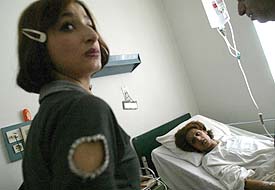 TEHRAN: Javad says he never felt quite right in his body, and for the past two years he has risked having his "arms and legs broken" by a family that refuses to accept his efforts to sort the problem out.
"I'd rather die than stay like this," said Javad, a fresh-faced young man who would rather be called "Hasti," a feminine name meaning "existence."
The idea of a man wanting to become a woman, or vice-versa, is something of a taboo the world over. And Islamic Iran - with its conservative values and male-dominated make-up - is no exception.
Source: [Daily Star]
Continue reading "Iran transsexuals: Get Islamic ok, face tough times"
Posted at 06:19 AM in Culture almighty, Features | Permalink | Comments (0) | TrackBack
Stereotypes bite back
By: Gloria Goodale Staff
(LOS ANGELES)In a scene from "Shark Tale," the latest animated film from Dreamworks,
a line of sharks waits to pay respects to the "codfather" of the reef,
Don Lino. The great white fish, voiced by Robert De Niro, has just lost
his two sons. Later, as Italian music plays in the background, the Don
and various underlings exchange lines that could be lifted from any
Mafia film all the way back to 1931's "Little Caesar."
"May whoever did this die a thousand deaths," says Giuseppe, a
hammerhead. The filmmakers have said that the film is a comedic sendup
of the old Italian mobster movies. But some Italian-Americans are not
amused. A national organization is protesting the film's "tired cliche
of Italians as mobsters."
"It's negative stereotyping at its worst," says Lawrence Auriana,
president of the New York-based Columbus Citizens Foundation, who saw
the film at last month's Toronto Film Festival. "The sharks all have
Italian names. They use Italian expressions and they are violent,
criminal, and racist."
Source: [Christian Science Monitor]
Continue reading "Stereotypes bite back"
Posted at 06:13 AM in Entertainment, Features, Politics | Permalink | Comments (0) | TrackBack
September 30, 2004
Jordan Acts to Curb a Rising Chorus of Critics
By Scott Wilson
AMMAN -- His arrest started as an invitation to coffee and ended three days later, when he walked out of a jail cell.
Ahmed Kafaween, a longtime leader of Jordan's most influential Islamic group, arrived at the provincial government building in the southern city of Karak one afternoon this month after being summoned for a chat by the police chief, who had kindly provided an escort.
"On August 20th, did you say during Friday prayer that the al-Aqsa mosque in Jerusalem was in danger of being destroyed by the Jews and that the United States supported its destruction?" Kafaween recalled being asked by an Interior Ministry agent, who was reading from a file. "Did you denounce other Arab governments for doing nothing about it?"
Source: [Wash Post]
Continue reading "Jordan Acts to Curb a Rising Chorus of Critics"
Posted at 10:25 AM in Features, Politics, War | Permalink | Comments (0) | TrackBack
September 27, 2004
A Graphic Film of Protest, and Cries of Blasphemy
By MARLISE SIMONS
AMSTERDAM - As she begins to pray, the woman looks heavily veiled, showing her eyes only, but her long black chador turns out to be transparent. Beneath it, painted on her chest and stomach, are verses from the Koran.
More women appear. A bride is dressed in white lace, but her back is exposed. The Koranic verse that says a man may take his woman in any manner, time or place ordained by God is written on her skin.
Source: [NY Times]
Continue reading "A Graphic Film of Protest, and Cries of Blasphemy"
Posted at 10:19 AM in Culture almighty, Features, Religion | Permalink | Comments (0) | TrackBack
September 26, 2004
Technology helps tie the knot
Technology can help us in some surprising areas. This can include organising an entire wedding, as Ian Hardy and his then fiancée Emily found out.
It took seven months to plan our dream day online: a "destination wedding" at the Bellagio Resort on the Las Vegas Strip, with guests from the UK, US and Hong Kong.
And we are not alone, according to Carley Roney, editor of The Knot.com.
Source: [BBC]
Continue reading "Technology helps tie the knot"
Posted at 10:04 AM in Culture almighty, Features | Permalink | Comments (0) | TrackBack
September 23, 2004
Anti-Terror Measures Delaying Green Cards
By Mary Beth Sheridan
The number of foreigners who became permanent U.S. immigrants dropped sharply in 2003 as anti-terrorism measures delayed the processing of applications, according to a new government report.
The report, by the Department of Homeland Security, showed that 705,827 people became legal permanent residents in fiscal 2003, down from 1.06 million the year before. The Washington area recorded a 22 percent decline. A permanent-resident document, known as a "green card," allows an immigrant to live and work indefinitely in the United States and is the first step toward citizenship.
Source: [Washington Post]
Continue reading "Anti-Terror Measures Delaying Green Cards"
Posted at 08:42 AM in Features, Politics | Permalink | Comments (0) | TrackBack
September 19, 2004
A family holiday to Syria?
Esther Selsdon
In a stone-vaulted souk in the shadow of the ancient citadel of Aleppo, five-year-old Edie was haggling for a bright red dress. Vigorously, she mimed the words: 'That's obviously a ridiculous price.' The trader smiled and agreed. 'You are', he said, 'welcome in my country.'
Our decision to take a family holiday in a country which is part of George Bush's supposed Axis of Evil had been prompted by a number of neatly colliding interests. We'd read about the ancient ruins of the cradle of western civilisation and birthplace of the Old Testament and we were keen to practise our painfully-acquired evening class Arabic on some real, live locals. But what Fergus, seven, and Edie really wanted was a journey on a 'sleepy train'.
Source [Guardian]
Continue reading "A family holiday to Syria?"
Posted at 06:16 AM in Features | Permalink | Comments (0) | TrackBack
September 18, 2004
Caught in Rebels' Cross Hairs: Iraqis Working for Americans
By SABRINA TAVERNISE
BAGHDAD, Iraq, Sept. 16 - One by one, they are dying. Gunned down on the highway on their way to work. Shot point-blank in front of their homes. Cornered in their cars.
Iraqis who work on American military bases are on the front lines of a secret war being waged by the country's violent insurgency. The killings are highly personal. Gunmen come to the homes and neighborhoods of the employees -interpreters, cleaners, clothes washers and carpenters - and shoot, often from expensive cars with expensive guns.
The killings, less visible than the high-profile kidnappings but just as lethal, single out Iraqis and send a chilling message not to cooperate with the Americans. They are crimes that the police, so overwhelmed with daily violence, rarely even bother to investigate. It is hard to say how many have died this way.
Source: [NY Times]
Continue reading "Caught in Rebels' Cross Hairs: Iraqis Working for Americans"
Posted at 04:16 AM in Features | Permalink | Comments (0) | TrackBack