May 13, 2005
In Kuwait, too many women are scorned
By Souheila Al-Jaada
Written on huge banners canvassing hundreds of town hall meetings organized by Islamists all across Kuwait is the following statement: "According to Islamic Sharia, women do not have political rights." This is part of a concerted effort by Muslim conservatives to stem a potential wave of reform in the country after Parliament, in a first round of voting, passed a bill granting women the right to vote and run in municipal elections.
The Islamists' plan worked. In the second round of voting in the middle of last week, the reform-minded government, which wrote the legislation, could not muster the majority votes needed to pass the bill. So, the Kuwaiti Parliament decided to delay consideration of the law and the government has now agreed to submit a new elections bill without a clause allowing women to vote.
This budding democratic process in Kuwait should be applauded, despite the fact that women's suffrage was rejected as result of Islamist political maneuvering. But what is disturbing about what happened is that Islamic conservatives are now sacrificing their own religion in order to win political battles and maintain traditions unrelated to Islam.
Source: [The Daily Star]
Continue reading "In Kuwait, too many women are scorned"
Posted at 06:30 AM in Commentary, Religion | Permalink | Comments (0) | TrackBack
April 16, 2005
Jordan falls from grace in Washington
By Maggie Mitchell-Salem
Is Jordan still the darling of U.S. President George W. Bush's campaign to reform, democratize and build free markets across the Middle East? From all outward appearances, the meeting between King Abdullah II and Bush last month in Washington was as warm as usual. But once the cameras were turned off, senior American officials made clear their discomfort with the stalled or, as one Jordanian official told me, "complacent" pace of reform in the kingdom.
Jordan's day of reckoning was long overdue. Questionably justifiable arrests, restrictions on the opposition-dominated trade unions, a less-than-free press, and heavy-handed secret police interference in daily life could no longer be excused. The bargain that Amman, like Cairo or even Damascus, hoped to maintain was regional good deeds in exchange for Washington's turning a blind eye to poor domestic performance. After all, no one really expected Bush to live up to his democracy-touting rhetoric, particularly when stability and security were at risk.
That proved wrong: Bush defied all expectations and walked the democratic walk. Worse still, the American threshold for defining Arab leaders as "reform-minded" is moving lower, like a limbo stick. Within days of the Abdullah-Bush meeting, public pressure mounted on the king for him to clear the stick.
Source: [Daily Star]
Continue reading "Jordan falls from grace in Washington"
Posted at 01:47 PM in Commentary | Permalink | Comments (0) | TrackBack
April 11, 2005
Listen to what Arabs say about freedom
WASHINGTON: Until the recent elections in Iraq and among the Palestinians, the modern Arab world was largely immune to the winds of democracy that have blown everywhere else in the world. Why? That's a pretty important question. For years, though, it was avoided in both the East and the West.
In the West, it was avoided because a toxic political correctness infected the academic field of Middle Eastern studies -- to such a degree that anyone focusing on the absence of freedom in the Arab world ran the risk of being labeled an "Orientalist" or an "essentialist."
It was also avoided because Western governments basically told Arab leaders that all they needed to do was keep their oil pumps open and their prices low and be nice to Israel. If they did all that, they could deny their own people the freedom America advocated everywhere else. Meanwhile, the Arab peoples were told by their own leaders and state-owned intellectuals that democracy had to come later -- after the nationalist struggle against colonialism or the liberation of Palestine or the creation of an Islamic state.
Source: [IHT]
Continue reading "Listen to what Arabs say about freedom"
Posted at 08:45 AM in Commentary | Permalink | Comments (0) | TrackBack
April 10, 2005
Cleaning up Jordan's musty politics
By Rana Sabbagh-Gargour
Half-hearted measures, and hesitant policies of the past, might have helped Jordan buy time and win Western support, but it did not consolidate the pioneering process of political reform, begun in 1989, when the rest of the Arab region was under despot rulers.
Now, Jordan needs to ensure domestic peace against rising poverty and unemployment, and brace for Washington's new approach that seems to promote rapid social and political change across the Arab world, without regard for internal stability.
The latest speed and direction of change, has left many in a state of shock and awe. In less than four days, the king re-organized the government, and staged a mini revolution at the Royal Court, his own backyard. And he set a clear agenda for where he wants Jordan to go: accelerate bold comprehensive reform, to complement economic modernization that has already taken firm hold in the kingdom, ever since he took over in 1999.
Source: [Daily Star]
Continue reading "Cleaning up Jordan's musty politics"
Posted at 12:47 AM in Commentary | Permalink | Comments (0) | TrackBack
April 08, 2005
The 10 best rock movies ever made
By Corey Levitan
Most rock movies suck. "Sgt. Pepper's Lonely Hearts Club Band," "Give My Regards to Broad Street," "One Trick Pony," "Magical Mystery Tour," Oliver Stone's "The Doors," and every Elvis flick other than "Love Me Tender" are some that spring immediately to mind.
Even Led Zeppelin's "The Song Remains the Same," which I watched 45 times since high school and would still watch again, sucks. But on those rare occasions when a movie gets rock utterly right -- the exhilaration, the communion, the attitude -- there is cause for celebration.
The American Film Institute's fourth annual Festival of Music Documentaries kicked off this week at the Arclight in Hollywood and runs until May 11. While I agree with most of AFI's choices -- "Talking Heads: Stop Making Sense," "Pass the Mic!," "Don't Need You," "Madonna: Truth or Dare" "Punk: Attitude," "Malfunkshun" -- I'd like to suggest a few for your own rock film festival.
Source: [Daily Breeze]
Continue reading "The 10 best rock movies ever made"
Posted at 11:30 PM in Commentary, Entertainment | Permalink | Comments (0) | TrackBack
April 04, 2005
The first world leader
By Timothy Garton Ash
The world lived this death. It was a global Calvary. People from every corner of the earth gathered in St Peter's Square, peering up at those two windows of the papal apartment, illuminated against the night sky. Across five continents, Christians, Jews and Muslims joined them through television. Marcello, from Rio de Janeiro, emailed CNN: "We are watching the agony of the greatest man of our time." Mohamed, from Birmingham, emailed the BBC: "He will be missed by Catholics and non-Catholics alike."
What does this tell us? It tells us that Pope John Paul II was the first world leader. We talk of Bush, Blair or Hu Jintao as "world leaders", but they are merely national leaders who have a world impact. That's true even of Nelson Mandela, his closest contender for Marcello's title of "greatest man of our time".
Pope John Paul II uniquely combined three elements. He was the head of the world's largest supranational organisation of individual human beings. (The UN is an organisation of states; the Islamic umma is not an organisation.) He believed withunshakeable conviction that his message was universal, applying equally to every man, woman and child - Catholics and non-Catholics alike.
Source: [Guardian]
Continue reading "The first world leader"
Posted at 11:45 PM in Commentary, Politics, Religion | Permalink | Comments (0) | TrackBack
John Paul the moderniser
By Marcin Krol
The death of Pope John Paul II was not unexpected, and his immense influence on the modern world will be judged and commented on by everybody who thinks that he has something to say. Before explaining one of the less known aspects of his teaching, it should be emphasised that one of the comments that is now being heard repeatedly is based either on stupidity or on a lack of understanding of what the Catholic Church is about: the charge that the Pope was and is “conservative” is nonsense.
John Paul II was undoubtedly conservative when he commented on Catholic dogma, but the institution of the Catholic Church is based on the Ten Commandments and dogmas which cannot be changed. Being truthful and faithful to what is the bedrock of church teaching cannot be deemed conservative.
On the other hand, John Paul II called “conservative” because he was against abortion and some other progressive ideas. But if you want a Pope who is for abortion, then you want a different church. Some things, some values that constitute both the faith and membership in the Catholic Church, are neither conservative nor liberal or progressive; they are fundamental, inevitable and immutable.
Source: [Jordan Times]
Continue reading "John Paul the moderniser"
Posted at 04:30 AM in Commentary, Religion | Permalink | Comments (0) | TrackBack
April 03, 2005
Pope John Paul II: Editorial
Pope John Paul II’s death last night will be mourned not just by the tens of millions of Roman Catholics around the world but also by other Christian denominations and followers of all other faiths. Muslims in the Middle East will feel the loss particularly deeply.
John Paul’s 26-year pontificate will go down as one of the more remarkable in the church’s history because he was not afraid to be strongly critical when he believed world leaders were behaving wrongly or dishonestly. From the very beginning of his reign, he announced his absolute support for peace and justice, not least for the Palestinians.
Remembering the man who had so often voiced sadness at the cycle of violence blighting the Holy Land, Palestinians gathered in the square in front of Bethlehem’s Church of the Nativity and kept up vigils for him. Nabil Abu Rudeina, spokesman for Palestinian leader Mahmoud Abbas, voiced the feelings of many: “He shared the sufferings of the Palestinian people ... We will miss him.” Palestinian Foreign Minister Nasser Al-Qidwa spoke for the world when he said that the pope “had contributed to building bridges between religions and civilizations and to consolidating the roots of peace and friendship between the peoples.”
Source: [Arab News]
Continue reading "Pope John Paul II: Editorial"
Posted at 11:30 PM in Commentary | Permalink | Comments (0) | TrackBack
March 31, 2005
CSI: Beirut
Syria is playing for time, and the Lebanese investigation into the Hariri assassination is a farce. Meanwhile, chaos is building.
By Christopher Dickey
No one is really laughing out loud, quite. The death count is already too high for that, and the clowns have still got guns and bombs, wiretaps and torture rooms. But there is, still, something grimly ludicrous about the disarray of Lebanon’s secret police and security services right now. As one of my good friends in Beirut puts it, “We are seeing the collapse of this regime in a very embarrassing, very clumsy, almost comical way—but it’s scary. You’re just sitting here watching the whole thing come apart.”
The headlines of the last few days and hours are symptomatic of the chaos building beneath the surface. Lebanese Prime Minister Omar Karami, unable to form a new government, will resign again, maybe. Syria has notified the United Nations in a formal letter that after 29 years it will withdraw its troops from Lebanon “before the coming elections.” But nobody’s sure just when that is. Theoretically the elections will take place before the Lebanese parliament’s term expires on May 31, but they could be stalled. Just four days ago, Syrian President Bashar al-Assad told a bunch of Spanish journalists that even if a timetable is announced next week, the final troop withdrawal “requires several months.”
The Syrians are playing for time like squatters facing a police eviction. They’re also trying to leave the back door open by keeping their key Lebanese cronies in place: not the prime minister, perhaps, and maybe not even the president at this point, but the clowns at the security services. The Lebanese opposition sees what’s going on, of course, and so do Washington and Paris. That’s why they’re pushing the U.N. Security Council this week to open up a full-scale international investigation into the Feb. 14 murder of former prime minister Rafik Hariri.
Source: [MSNBC]
Continue reading "CSI: Beirut"
Posted at 12:45 PM in Commentary, La Revolutione | Permalink | Comments (0) | TrackBack
March 28, 2005
Jordan must democratize to be spared U.S. wrath
By Rana Sabbagh-Gargour
Jordan must today make a clear choice to initiate bold political reform, or lose face at home and invite interference from abroad. For now it has managed to deflect close foreign scrutiny of its teetering political reform efforts, mostly on the strength of its backing for Washington's policies, the war on terror, and its diplomatic ties with Israel. However, these issues remain deeply unpopular in a country where the majority of the population is anti-American.
But time is no longer on the Jordanian government's side. A breeze of democracy is blowing across the Middle East, whether in Palestine and Iraq, both of which remain under foreign occupation, in autocratic Egypt and Saudi Arabia, or in Lebanon. Jordan realizes it has to move fast, now that U.S. President George W. Bush is waging a fierce battle to spread democracy and economic reform throughout the region. Hesitant policies during the past decade, which have turned Jordan into a "liberalized autocracy" overseeing a corporate economy rather than a constitutional monarchy with elected governments, do not work any longer.
This shady strategy has raised concern among the Jordanian business and political elite alike: soon the kingdom may no longer be the darling of the West. Other emerging pro-Western democracies could surpass Jordan as a genuine political model. Those in the elite feel that it is inevitable that the U.S. will eventually turn its attention to Amman, and will not tolerate further clampdowns by the intelligence services on activists and opposition groups, while keeping a tight grip on the country as in other states in the Middle East.
Source: [Daily Star]
Continue reading "Jordan must democratize to be spared U.S. wrath"
Posted at 06:30 PM in Commentary | Permalink | Comments (0) | TrackBack
Playing Both Sides in Jordan
By Jim Hoagland
Pop quiz: Which Arab ruler is to George W. Bush as Yasser Arafat was to Bill Clinton? Congratulations if you said King Abdullah of Jordan. And a tip of the hat to all those Iraqis who came up with the answer so fast. You know your neighborhood, and your neighbor.
Abdullah emulates Arafat in possessing special, drop-in-anytime visiting rights to the White House and in merchandising that access to puff up his influence at home and with other Arab leaders. The Jordanian monarch seizes every opportunity to see and be seen with the U.S. president and his senior aides. Rather than attend an Arab summit to support his unconvincing, warmed-over version of a "peace plan" with Israel, Abdullah was again stateside last week, basking in the glow of meetings with Bush and Secretary of State Condoleezza Rice.
And, as Arafat did, Abdullah works against U.S. interests in Iraq and elsewhere while pretending otherwise. The youthful Jordanian autocrat pulls the wool over the eyes of a Republican president as the deceased Palestinian revolutionary did with Bush's Democratic predecessor.
If there is a difference in the comparative equation, it is likely that Clinton distrusted Arafat more. In Abdullah's case, Bush again displays a disturbing tendency to overinvest in the swagger and guile of people who run or who are close to spy agencies. (See Tenet, George, and Putin, Vladimir, for details.)
Source: [Washington Post]
Continue reading "Playing Both Sides in Jordan"
Posted at 03:00 PM in Commentary | Permalink | Comments (0) | TrackBack
March 21, 2005
A Nobel for Sistani
By Thomas L. Friedman
As we approach the season of the Nobel Peace Prize, I would like to nominate the spiritual leader of Iraq's Shiites, Grand Ayatollah Ali al-Sistani, for this year's medal. I'm serious.
If there is a decent outcome in Iraq, President Bush will deserve, and receive, real credit for creating the conditions for democratization there, by daring to topple Saddam Hussein. But we tend to talk about Iraq as if it is all about us and what we do. If some kind of democracy takes root there, it will also be due in large measure to the instincts and directives of the dominant Iraqi Shiite communal leader, Ayatollah Sistani.
It was Mr. Sistani who insisted that there had to be a direct national election in Iraq, rejecting the original goofy U.S. proposal for regional caucuses. It was Mr. Sistani who insisted that the elections not be postponed in the face of the Baathist-fascist insurgency. And it was Mr. Sistani who ordered Shiites not to retaliate for the Sunni Baathist and jihadist attempts to drag them into a civil war by attacking Shiite mosques and massacring Shiite civilians.
In many ways, Mr. Sistani has played the role for President George W. Bush that Nelson Mandela and Mikhail Gorbachev played for his father, President George H. W. Bush. It was Mr. Mandela's instincts and leadership - in keeping the transition to black rule in South Africa nonviolent - that helped the Bush I administration and its allies bring that process in for a soft landing. And it was Mr. Gorbachev's insistence that the dismantling of the Soviet Empire, and particularly East Germany, be nonviolent that brought the Soviet Union in for a soft landing.
Source: [NY Times]
Continue reading "A Nobel for Sistani"
Posted at 07:45 PM in Commentary | Permalink | Comments (0) | TrackBack
March 19, 2005
Arabs still the baddies on U.S. TV
Popular television programs portray Muslim Americans as traitors and terrorists three years after 9/11
By Jack G. Shaheen
ILLINOIS -- The American entertainment industry's boogeyman is on the loose again. On the critically acclaimed television show "24," American Muslims and American Arabs are being demonized once more. It all started with the 2002 CBS movie "The President's Man: A Line In the Sand," where American Arabs and some Arabs who aren't citizens get together to nuke Texas.
Then Fox struck, cramming 13 episodes of "24" into its 2002-2003 season. The show embellished "The President's Man" storyline, showing Arab American and Arab terrorists out to nuke Los Angeles.
Now, "24" is rehashing the same biased plot - American Muslims out to nuke our country, killing neighbors in the process. So far the protagonist, Jack Bauer, played by Kiefer Sutherland, has gunned down 100 Muslim American "fanatics."
Fox isn't alone.
Source: [Daily Star]
Continue reading "Arabs still the baddies on U.S. TV"
Posted at 05:30 PM in Commentary, Media Watch | Permalink | Comments (0) | TrackBack
A Prayer Toward Equality
By Mona Eltahawy
NEW YORK -- Today, somewhere in New York, a Muslim woman will give the sermon that precedes the congregational noon prayers, called Jum'ah, that mark the highlight of the Muslim week. She will then lead men and women in prayer, becoming the first woman on record to lead a public, mixed-gender Friday prayer.
I can't tell you where the prayer will be held because I don't know yet. The location is being kept secret because the original venue backed out after it received threats for opening its doors to such a service.
But I can tell you that the courage of Amina Wadud, a professor of Islamic studies at Virginia Commonwealth University who will lead us all, is impossible to describe. And I can tell you what a thrill it will be to stand before God as the spiritual equal of the male congregants -- praying together, not behind the men and not in another room -- with a woman leading us.
There is nothing in Islam that bars a woman from giving the Friday sermon or from leading a mixed-gender prayer. The fact that only men have done both for centuries is one of many things that Muslims have rarely questioned. We have wasted time and energy circling the same old subjects: Just how much of woman's body should be covered; can men and women shake hands, etc.
By standing behind Amina Wadud today, we will be clearing the deck of distractions and acknowledging the egalitarianism that permeates Islam. My faith resides deep in my heart, but it has been hard at times to reconcile my heart with my mind, which too often recoils at the blatant misogyny that centuries of male-dominated interpretation of my religion have wrought.
Source: [Washington Post]
Continue reading "A Prayer Toward Equality"
Posted at 11:30 AM in Commentary, Religion | Permalink | Comments (0) | TrackBack
March 11, 2005
The Beirut Tea Party
By Thomas L. Friedman
The massive pro-Syrian demonstration that the Hezbollah militia mounted on the streets of Beirut on Tuesday underscored just how much all the old slogans and sentiments - anti-Israeli, anti-American, pro-Islamist, sectarian - can be exploited by Syria, Iran and their local proxies to still mobilize popular forces against change. It is also another reminder that the Berlin Wall is falling in the Arab world, but Vaclav Havel, Lech Walesa and the Solidarity trade movement are not on the other side, just waiting to jump into the arms of the West. It is a much more divided, complex, confused and, at times, angry group.
Consider the message that the leaders of Iran, Syria and Hezbollah were sending to President Bush through their mass rally in Beirut: "Hey, Bush, you want a piece of us? Well, come and get it. Remember what Stalin said about the pope: how many divisions does he have? When it comes to divisions on the ground, pal, we've got 'em. You don't. So nobody is going to remake Lebanon without our permission and without our interests being taken into account."
What is the right response to this? I would begin my answer with an assertion: What we have been seeing in the outbursts of democracy in the streets of Beirut, Baghdad, Cairo and even Riyadh is something real and authentic. It is driven both in response to particular events - like the murder of the former Lebanese prime minister Rafik Hariri - and in response to a deep longing in this part of the world for a different future, particularly among young people, who know what is going on elsewhere and want their own piece of the freedom pie.
Source: [NY Times]
Continue reading "The Beirut Tea Party"
Posted at 01:00 AM in Commentary | Permalink | Comments (0) | TrackBack
March 08, 2005
Brave, Young and Muslim
By Thomas L. Friedman
The last couple of years have not been easy for anyone, myself included, who hoped that the Iraq war would produce a decent, democratizing outcome. And even in the wake of the remarkable Iraqi election, the toppling of the Lebanese cabinet and the reforms brewing in Egypt, it is too soon for anyone to declare victory. We're dealing with some very unstable chemicals. But what makes me more hopeful today is precisely what made me hopeful that the Iraq war might work out, and that is the number of Arab-Muslim youth I've encountered since 9/11 who have urged me to keep writing about the need for democracy and reform in their part of the world.
Of course, many Americans are surprised by this. America has treated the Arab-Muslim states for 50 years as a collection of gas stations. All we cared about was that their pumps were open and their prices low, and that they be nice to the Israelis. As long as the regimes did that, we said, they could do whatever they wanted "out back." They could treat their women however they wanted, they could write about America in their newspapers however they wanted, and they could preach intolerance of other religions all they wanted - just keep their pumps open and prices low and be nice to the Israelis. On 9/11, we got hit with everything that was going on "out back."
Since then, it's been clear to me that unless we partner with Arabs and Muslims to change their context, unless we help them create the free space for a war of ideas that will allow for a new discussion out front and out back, we're just begging for another 9/11. I always knew we had partners there, but the democratic movements that have now emerged have shown me just how many young people there want to give voice to their aspirations and achieve their full potential - something their governments and spiritual leaders have been blocking.
Source: [NY Times]
Continue reading "Brave, Young and Muslim"
Posted at 06:11 PM in Commentary | Permalink | Comments (0) | TrackBack
March 06, 2005
Unexpected Whiff of Freedom Proves Bracing for Mideast
By Neil MacFarquhar
CAIRO - The leaders of about half of Egypt's rickety opposition parties sat down for one of their regular meetings this week under completely irregular circumstances. In the previous few days, President Hosni Mubarak opened presidential elections to more than one candidate, and street demonstrators helped topple Lebanon's government.
The mood around the table in a battered downtown Cairo office veered between humor and trepidation, participants said, as they faced the prospect of fielding presidential candidates in just 75 days. "This is all totally new, and nobody is ready," said Mahmoud Abaza, deputy leader of the Wafd Party, one of Egypt's few viable opposition groups. "Sometimes even if you don't know how to swim you just have to dive into the water and manage. Political life will change fundamentally."
The entire Middle East seems to be entering uncharted political and social territory with a similar mixture of anticipation and dread. Events in Lebanon and Egypt, following a limited vote for municipal councils in Saudi Arabia and landmark elections in Iraq, as well as the Palestinian territories, combined to give the sense, however tentative, that twilight might be descending on authoritarian Arab governments.
A mix of outside pressure and internal shifts has created this moment. Arabs of a younger, more savvy generation appear more willing to take their dissatisfaction directly to the front stoop of repressive leaders.
Source: [NY Times]
Continue reading "Unexpected Whiff of Freedom Proves Bracing for Mideast"
Posted at 05:45 PM in Commentary, Politics | Permalink | Comments (0) | TrackBack
March 05, 2005
The Arab Street: A vanquished cliché
By Christopher Hitchens
The return of politics to Iraq has had many blissful secondary consequences, one of them apparently minor but nonetheless, I think, important. When was the last time you heard some glib pundit employing the phrase "The Arab Street"? I haven't actually done a Nexis search on this, but my strong impression is that the term has been, without any formal interment, laid to rest. And not a minute too soon, either.
In retrospect, it's difficult to decide precisely when this annoying expression began to expire, if only from diminishing returns. There was, first, the complete failure of the said "street" to detonate with rage when coalition forces first crossed the border of Iraq, as had been predicted (and one suspects privately hoped) by so many "experts." But one still continued to hear from commentators who conferred street-level potency on passing "insurgents." (I remember being aggressively assured by an interviewer on Al Franken's quasi-comedic Air America that Muqtada Sadr's "Mahdi Army" in Najaf was just the beginning of a new "Tet Offensive.") Mr. Sadr duly got a couple of seats in the recent Iraqi elections. And it was most obviously those elections that discredited the idea of ventriloquizing the Arab or Muslim populace or of conferring axiomatic authenticity on the loudest or hoarsest voice.
The London-based newspaper Al Quds al-Arabi, which has for some time been a surrogate voice for "insurgent" talk in the Arab diaspora, polled its readers after the Iraqi elections and had the grace to print the result. About 90 percent had been favorably impressed by the sight of Iraqi and Kurdish voters waiting their turn to have a say in their own future.
Source: [Slate]
Continue reading "The Arab Street: A vanquished cliché"
Posted at 09:30 PM in Commentary | Permalink | Comments (0) | TrackBack
March 04, 2005
When in Doubt, Blame Syria
By Linda Heard
Those who want to get with the latest US program must put the blame on Syria. What for? Doesn’t matter in the least. Whether it is for the two world wars, the demise of Elvis or sinking the Titanic, Syria makes a handy and eminently fashionable punching bag. Even if Syria’s accusers get it wrong, no matter. Syria’s friends are one by one deserting an apparently sinking ship.
The US clearly blames Syria for the assassination of Rafik Hariri in downtown Beirut. It hasn’t said so in so many words. Instead, it has pulled out its ambassador and has engaged in the quest of isolating Syria from Lebanon.
Never mind that given the current climate, Hariri’s death was not in Syria’s interests. It didn’t need a clairvoyant to anticipate the passing of “Mr. Lebanon” would destabilize the region, sharpen the anti-Syrian knives, and perhaps pit Lebanese against Lebanese. So what did Syria have to gain?
When a suicide bomb recently exploded on the Tel Aviv waterfront, the Israeli government, in a marked departure, immediately went for Syria’s jugular. Syria is behind those deaths, it said, while putting its dialogue with the Palestinians on ice, just for good measure.
Source: [Arab News]
Continue reading "When in Doubt, Blame Syria"
Posted at 01:00 AM in Commentary, Politics | Permalink | Comments (1) | TrackBack
February 28, 2005
'How many more women have to die?'
By Tony Paterson
Shortly before nine o'clock one Monday evening earlier this month, Hatin Sürücü left her five-year-old son asleep in their small apartment in the Tempelhof district of Berlin and made her way to a bus stop in the main Oberlandgarten Strasse.
Minutes later, a volley of pistol shots rang out but no one came to help Mrs Sürücü, 23, who was of Turkish origin. A bus driver discovered her body, with multiple wounds to the head and chest, about 40 minutes later and called the police.
Last week, Mrs Sürücü's three brothers, aged 18 to 25, who were arrested six days after the attack, were formally charged with the murder. They have pleaded not guilty and were remanded in custody.
Police are investigating whether Mrs Sürücü was the victim of a so-called "honour killing" after she made the decision to leave the cousin with whom she had been forced into an arranged marriage eight years earlier. The police said that Mrs Sürücü had frequently complained of being threatened by her brothers.
If they are found guilty, Mrs Sürücü's murder will be the sixth "honour killing" within Berlin's 200,000-strong Muslim community in four months. Shocking as that is, the reactions of some Turkish immigrant children at a school whose main gates are yards from the scene of the shooting has caused even graver concern.
Source: [Telegraph]
Continue reading "'How many more women have to die?'"
Posted at 02:47 PM in 'Honor' Crimes, Commentary, Religion | Permalink | Comments (0) | TrackBack
February 17, 2005
Hariri: A murder of little mystery
By Amir Taheri
WHO killed Rafik Hariri and why? The question will haunt the politics of Lebanon, and of the Middle East beyond it, for some time to come.
A former Lebanese prime minister, Hariri had established himself as a major figure in the regional politics, one capable of offering his nation leadership at a time when the status quo in the Middle East faces major changes.
Initial attempts by Arab conspiracy theorists to pin the crime on Israel and/or the United States fizzled out quickly. A pro-Syrian Lebanese politician who claimed that the murder had been jointly organized by Washington and Paris was laughed off Arab TV screens. Even Al-Jazeera, home of Arab conspiracy theories, wouldn't swallow that one. Nor could anyone lend credence to an anonymous claim by "Victory and Jihad," a hitherto unknown, and probably nonexistent, group.
So: Who did it and why?
Source: [NY Post]
Continue reading "Hariri: A murder of little mystery"
Posted at 11:56 PM in Commentary | Permalink | Comments (0) | TrackBack
Hairi assassination: 'Hama Rules'
By Thomas L. Friedman
About two weeks ago, a friend of former Lebanese Prime Minister Rafik Hariri stopped by my office to update me on Lebanon and pass on a message from Mr. Hariri, whom I have known since reporting from Beirut in the late 1970's. The message was that the Lebanese opposition to the Syrian occupation was getting united - inspired both by the example of Iraq and by the growing excesses of the Syrian occupation. Mr. Hariri, his friend said, was planning to use the coming Lebanese parliamentary elections, and a hoped-for victory by the opposition front, to send a real message to the Syrians: It's time for you to go.
There is no excuse anymore for Syria's occupation of Lebanon, other than naked imperialism and a desire to siphon off Lebanese resources. If the U.S. government and media really care about democracy in the Arab world, Mr. Hariri's envoy said, then the U.S. has to get behind those trying to rescue the oldest real Arab democracy, Lebanon, from the Syrian grip.
Well, Rafik, this one's for you. I am sorry you won't be able to read it.
It will be difficult to prove who killed Mr. Hariri. But the gang ruling Syria had all the ability, experience and motive to murder the Lebanese statesman for the way he had teamed up with Paris and Washington to pass the recent U.N. resolution, 1559, calling for Syria's immediate withdrawal from Lebanon. Mr. Hariri pressed for that U.N. resolution, and resigned his office, after Syria perverted Lebanese democracy by forcing Lebanon's Parliament to accept a three-year extension for a Syrian puppet, Émile Lahoud, as Lebanon's president.
Source: [NY Times]
Continue reading "Hairi assassination: 'Hama Rules'"
Posted at 05:41 PM in Commentary | Permalink | Comments (0) | TrackBack
February 13, 2005
Iranian Blogger Commits 'Crime' Against the State
By Farouz Farzami (Farouz Farzami is the pseudonym of an Iranian journalist)
TEHRAN — "Excuse me, Miss, but here in my hand I have a warrant for your arrest," said a middle-aged man with a few days' growth of beard. "Please do not make any noise as you walk calmly to the Mercedes parked at the corner."
When the man approached me, I had just left a bookstore. It crossed my mind to resist, but I thought better of it.
In the car, I was flanked by two broad-shouldered men in black jackets. The man with the arrest warrant drove up Enqelab Avenue and waved the arrest warrant to assure me they were not kidnappers. "We are from the judiciary branch, and everything will be done within the framework of Islamic law," he said. "Do not worry. The whole thing should not last more than a couple of hours."
I was annoyed but relieved, and not especially surprised. Arrest and interrogation of anyone who writes stories critical of the regime has become commonplace in Iran. I am a blogger, and I have written often and honestly about life in my country, so it's an occupational hazard.
Souce: [LA Times]
Continue reading "Iranian Blogger Commits 'Crime' Against the State"
Posted at 09:44 AM in Commentary, Weblogs | Permalink | Comments (0) | TrackBack
February 06, 2005
Director Ziad Doueri's growing pains
 By Jim Quilty
BEIRUT: Reputations made with a first film, they say, can be lost with a second. The adage comes to mind when watching Ziad Doueri's latest. "Lila dit a" ("Lila Says") is a less-satisfying, less-successful work than "West Beyrouth," but it has its moments of beauty and should not be dismissed out of hand.
"Lila" is a coming-of-age tale that focuses on Chimo (Mohammed Khouas), a sensitive young man emerging from adolescence in a working class, largely immigrant quarter of Marseilles. Like many sensitive young men, he doesn't spend his whole day sitting around reading poetry - he knocks around town getting into mischief with three pals.
Since all four are Franco-Arabs in the post-Sept. 11, 2001, universe, being hassled by the cops is part of the process as much as getting drunk. So is sticking their noses into the local mosque to check out what the sheikh has to say. None of this business is pursued in any detail. Though they evidently have pious friends, none of Chimo's pals seems to be serious-minded enough to either engage with Islam or reject it.
Source: [Daily Star]
Continue reading "Director Ziad Doueri's growing pains"
Posted at 05:30 PM in Commentary, Entertainment | Permalink | Comments (1) | TrackBack
February 01, 2005
Europe's Left in Denial over Iraqi Vote
The European left's attempts at damage control came right away. Just hours after the scenes viewed around the world of joyous and determined Iraqis defying terrorists by casting their votes, Germany's Social Democratic parliamentary group sent out a press release with the following headline: "Iraq elections: A good step but no retroactive justification for the war."
It says much about the decline of Germany's left (and Europe's for that matter) that the removal of a fascist dictator and the spread of democracy cannot be considered a worthy end in itself -- at least not if the dictator is Arab and the liberators American.
The same bias runs through much of Europe's media. According to a common narrative, nothing good could possibly come out of this "illegitimate" war. But that their ideological zeal to uncritically condemn American policy surpasses that of Arab media surely should be cause for some introspection.
Source: [Wall Street Journal]
Continue reading "Europe's Left in Denial over Iraqi Vote"
Posted at 12:23 PM in Commentary | Permalink | Comments (0) | TrackBack
January 26, 2005
Circumventing the state in Egypt, online
By Omayma Abdel-Latif
In the face of Arab governments' ongoing, heavy-handed efforts to control public debate, the Internet has emerged as a platform for voices - especially those of Islamists - denied a place in the mainstream, state-owned media. Contrary to the widespread Western perception that radical Web sites dominate Islamist cyberspace, groups embracing a moderate interpretation of the faith increasingly are launching sites to "break the monopoly of the state over the articulation of the political and social agenda," as one activist described it. These sites aim particularly to attract younger Muslims by addressing their concerns and providing an interpretation of Islam couched in modern lingo disseminated by modern technology. Egypt has been a key location for such cyber-initiatives.
"Does Islam only allow force in self-defense or can it also be used to remove oppression?" This is but one of the many questions on matters of politics, religion, love, marriage and health that the Cairo-based Islamonline Web site [www.islamonline.net] receives on an hourly basis from Muslims across the globe. Part of a boom of Web sites offering new perspectives on the Muslim faith, Islamonline was launched in 1999 by a group of Egyptian Islamist intellectuals.
In the words of its founders, Islamonline's main objective is "to work for the good of humanity and to support principles of freedom, justice, democracy and human rights." Besides its 24-hour news service, the Web site provides a wealth of information on issues related to women, religious rulings, or fatwas, interviews with Muslim scholars, and reflections on Islamic thought and jurisprudence.
Souce: [Daily Star]
Continue reading "Circumventing the state in Egypt, online "
Posted at 01:14 PM in Commentary | Permalink | Comments (0) | TrackBack
January 22, 2005
A Schmear Campaign
BY Alan Bromley
NEW YORK--Across the street from my office on West 26th Street is a deli owned by an Arab fellow named Muhammed. He has a TV that hangs from the ceiling and is always tuned to CNN. One day the network was showing footage of tsunami devastation, and I remarked, "It looks worse than a nuclear attack."
"That's what I think it was," he responded. "This wasn't an earthquake, it was an underwater nuclear bomb!"
Shocked that he took my metaphor and flipped a natural disaster into a political bomb, I asked, "Who set it off? Why would they do that? And who do you blame for the 9/11 massacre?" I pushed, as I awaited my toasted bagel with cream cheese.
"The Zionists! The Americans!" he shouted. Other patrons moved away, putting their orders "on hold ... The Jews stayed away from the towers on 9/11," he continued.
Source: [Opinion Journal]
Continue reading "A Schmear Campaign"
Posted at 01:59 PM in Commentary | Permalink | Comments (0) | TrackBack
January 18, 2005
Pop-Tarts or Freedom?
By Thomas L. Friedman
In the wake of U.S. aid to help Muslim and other victims of the recent tsunami, Colin Powell suggested that maybe, now that the Muslim world had seen "American generosity" and "American values in action," it wouldn't be so hostile to America.
Don't hold your breath waiting for a thank-you card. If the fact that American soldiers have risked their lives to save the Muslims of Bosnia, the Muslims of Kuwait, the Muslims of Somalia, the Muslims of Afghanistan and the Muslims of Iraq has earned the U.S. only the false accusation of being "anti-Muslim," trust me, U.S. troops passing out bottled water and Pop-Tarts in Indonesia are not going to erase that lie. It is not an exaggeration to say that, if you throw in the Oslo peace process, U.S. foreign policy for the last 15 years has been dominated by an effort to save Muslims - not from tsunamis, but from tyrannies, mostly their own theocratic or autocratic regimes.
It clearly has not made much of an impression. So you will pardon me if I say that I don't care whether the state media in Saudi Arabia - whose government gave far less to the Muslim tsunami victims ($30 million) than the amount spent by King Fahd's entourage on his last two vacations in Marbella (reportedly $100 million) - say nice things about us.
Source: [NY Times]
Continue reading "Pop-Tarts or Freedom?"
Posted at 03:57 PM in Commentary | Permalink | Comments (0) | TrackBack
January 14, 2005
Ballots and Boycotts
By THOMAS L. FRIEDMAN
In trying to think through whether we should press ahead with elections in Iraq or not, I have found it useful to go back and dig out my basic rules for Middle East reporting, which I have developed and adapted over 25 years of writing from that region.
Rule 1 Never lead your story out of Lebanon, Gaza or Iraq with a cease-fire; it will always be over by the time the next morning's paper is out.
Rule 2 Never take a concession, except out of the mouth of the person who is supposed to be doing the conceding. If I had a dime for every time someone agreed to recognize Israel on behalf of Yasir Arafat, I would be a wealthy man today.
Rule 3 The Israelis will always win, and the Palestinians will always make sure that they never enjoy it. Everything else is just commentary.
Rule 4 In the Middle East, if you can't explain something with a conspiracy theory, then don't try to explain it at all - people there won't believe it.
Source: [NY Times]
Continue reading "Ballots and Boycotts"
Posted at 01:18 AM in Commentary | Permalink | Comments (0) | TrackBack
December 17, 2004
Holding Up Arab Reform
By THOMAS L. FRIEDMAN
DUBAI, United Arab Emirates - For years now it's been clear that the Middle East peace process has left the realm of diplomacy and started to become an industry, with its own G.N.P. of conferences and seminars. But there is a new industry rapidly overtaking it in the Middle East, and that is the "reform industry." Every month there seems to be a new conference on reform in the Arab world. Indeed, I have been attending one here in Dubai, an amazing city-state on the Persian Gulf that is becoming the Singapore of the Arab East.
What the reform process and the peace process have in common is that neither advances when we Americans tell the parties in English that they have to change. Progress happens only when the people here tell themselves in Arabic that they must change. So I took heart from the blunt manner in which Dubai's crown prince, Sheik Mohammed bin Rashid al-Maktoum, opened his conference by saying, in a speech broadcast by Arab satellite TV, "I say to my fellow Arabs [in power]: If you do not change, you will be changed."
Source: [NY Times]
Continue reading "Holding Up Arab Reform"
Posted at 02:38 PM in Commentary | Permalink | Comments (0) | TrackBack
December 15, 2004
Arabs and Globalization: Encroaching Identity Crisis
By Ramzy Baroud
Thanks to “Western imperialism” and the “shrewd ways of international Zionism” Arabs, we are told, remain out of touch with an array of social and cultural crises that have plagued their societies.
Problems and challenges in the Arab world are molded in so clever a way that the blame for them falls on someone else.
Contextualizing social diseases within a larger political framework is often helpful, but in the Arab world this practice is grossly misused. Washington’s Middle East foreign policy tells a great deal about the US political culture, the Middle East’s receptiveness to the abuses imposed by that culture and mute response to the subsequent challenges posed.
Source: [Arab News]
Continue reading "Arabs and Globalization: Encroaching Identity Crisis"
Posted at 02:13 PM in Commentary | Permalink | Comments (0) | TrackBack
December 11, 2004
Stop splitting hairs on 'terrorism'
By Ammar Abdulhamid
Many people around the world today seek to differentiate between what they call "freedom fighters" and those described as terrorists. They argue that such differentiation, which is most often applied to Iraq and the Palestinian-Israeli conflict, is necessary in order to grant legitimacy to those fighting for their freedom or the independence of their homeland against an oppressor or a foreign occupier, especially when the reality of occupation is recognized internationally, perhaps through relevant UN resolutions.
The problem with this argument, however, is that it tends to grant blind sanction for any acts perpetrated by the so-called freedom fighters, even when these are directed against civilian targets, or when they reveal callous disregard for the possibility of provoking civilian casualties.
Historically, freedom fighters have never been overly sensitive to the possibility that their actions might kill or wound civilians. However, public concern for civilian victims, especially when incurred as a result of guerrilla warfare or suicide bombings, has grown immensely during the last 15-20 years as a result of progress in media coverage and the highly sensationalist nature of the visual media.
Although, one can make a case that media coverage is often biased in this regard, the point remains the same: Current world opinion has little tolerance or sympathy for acts that are increasingly perceived as terrorist in nature.
Source: [Daily Star]
Continue reading "Stop splitting hairs on 'terrorism'"
Posted at 10:51 PM in Commentary, War | Permalink | Comments (0) | TrackBack
December 05, 2004
Al-Jazeera’s 'Psyops'
By Hassan Hanizadeh
The Al-Jazeera network’s recent insult of the Iranian nation was totally unacceptable. The Arabic network, which broadcasts its programs from the little Arab country Qatar, has recently posted an insulting cartoon about the Islamic Republic of Iran on its English site.
In the cartoon, a cleric, who is the symbol of the Islamic Republic of Iran, indifferently passes by various scenes of the current problems in the Islamic world, but reacts strongly when he sees that the name of the Persian Gulf has been changed to the unacceptable “Arab Gulf”.
Iranian officials made a prompt denunciation of this very amateurish and dishonorable measure, which has its roots in Al-Jazeera officials’ animosity toward Iranians.
Source: [Tehran Times]
Continue reading "Al-Jazeera’s 'Psyops'"
Posted at 11:19 AM in Commentary, Media Watch, The Curious | Permalink | Comments (0) | TrackBack
Al Jazeera: More Doha datelines and an ethical code
By S. Abdallah Schleifer
In a fast-changing world, easy observations remain in consciousness long after they have become invalid. So it is with the conceit that Al Jazeera put Qatar on the map and not visa versa, or the variant that Al Jazeera is more important as a regional power than the State of Qatar.
That may have been true eight years ago, but even then it was a theoretically dubious proposition since it was only Qatar or its newly installed Emir, HH Sheikh Hamad Bin Khalifa Al Thani who had the vision among all Arab rulers of hosting and financing on Arab soil the first relatively free-wheeling, independently managed, Arab satellite television channel. Until then relatively independent pan-Arab satellite broadcasting carrying serious news bulletins had been confined to the United Kingdom, with MBC operating out of London and the BBC Arabic Television Service producing for Orbit, which in turn was based in Italy
Source: [TBS]
Continue reading "Al Jazeera: More Doha datelines and an ethical code"
Posted at 11:16 AM in Commentary, Media Watch | Permalink | Comments (0) | TrackBack
November 25, 2004
Look Who Isn't Talking
A filmmaker is murdered, and Hollywood loudmouths say nothing.
BY BRIDGET JOHNSON
Since Nov. 2, I've had an icky feeling in the pit of my stomach. As an ardent Bush backer, my queasiness has nothing to do with the glorious election results, but is prompted by a murder that occurred the same day in Amsterdam.
Dutch filmmaker Theo van Gogh's short film "Submission," about the treatment of women in Islam, written by female Dutch parliamentarian and former Muslim Aayan Hirsi Ali, had aired in August on Dutch TV. Van Gogh was riding his bike near his home when a Muslim terrorist shot him, slashed his throat, and pinned to his body a note threatening Ms. Ali. This appears to be an organized effort, not the act of a lone nut; Dutch authorities are holding 13 suspects in the case. [see related story]
After the slaying, I watched "Submission" and my mind is still boggled that 11 minutes decrying violence against women incites such violence. There've been many films over the years that have taken potshots at Catholics, but I don't remember any of us slaughtering filmmakers over the offense. You didn't see the National Rifle Association order a hit on Michael Moore over "Bowling for Columbine."
Source: [Wall St. Journal]
Continue reading "Look Who Isn't Talking"
Posted at 06:56 PM in Commentary, Entertainment, Politics | Permalink | Comments (0) | TrackBack
November 19, 2004
Under the Cover of Islam
By IRSHAD MANJI
As a young Canadian Muslim who has called for reform in Islam, I've been traveling throughout North America and Europe over the past year. Last week, I toured France and Spain. God help me.
I didn't expect a warm reception from fellow Muslims. But now, I'm also not sure that liberal Muslims like me fit comfortably in a secular European crowd. I say this even after the murder of Theo van Gogh, the Dutch filmmaker, who police officials say was shot and stabbed by a Muslim extremist. Mr. van Gogh had exercised his right to criticize Islam - a right that I, as a modern Muslim, defend unequivocally.
What then gives me the sense that even modern Muslims can't be modern enough for Western Europe? It's precisely that, from Amsterdam to Barcelona to Paris to Berlin, people incredulously ask me one type of question that I'm never asked in the United States and Canada: Why does an independent-minded woman care about God? Why do you need religion at all? [See related story]
Source: [NY Times]
Continue reading "Under the Cover of Islam"
Posted at 01:57 PM in Commentary, Religion | Permalink | Comments (0) | TrackBack
A Little Late, but a Stand Against Hate
By CLYDE HABERMAN
AFTER the Sept. 11 attacks by Islamic terrorists, Ginan Rauf's 12-year-old son asked a question that shook her, she says, "to the core." The boy, Sherif Ahmed, was in "deep despair and shock," said Ms. Rauf, a Muslim living in Franklin Lakes, N.J. His question could not have been blunter: "Mom, does anything good ever come out of the Muslim world?"
Her instinctive response, the mother recalled yesterday, was to say that of course there are good things, that people of their religion "have made so many contributions to human civilization." But there was no avoiding the obvious. Islam, for many, including quite a few born in the faith, had become grim, cramped, exclusionary and - no getting around it - all too often death-embracing.
Source: [NY Times]
Continue reading "A Little Late, but a Stand Against Hate"
Posted at 01:51 PM in Commentary, Religion | Permalink | Comments (0) | TrackBack
A Saudi Protest March
Demonstrators march for women's rights in front of the Saudi embassy. It's a start.
by Stephen Schwartz
MOST PEOPLE, both inside the Saudi kingdom and outside it, would agree that it will be a cold, cold day before the rulers of Riyadh grant rights to women. Nevertheless, on a crisp, cold, and clear Saturday, November 13, a protest materialized in front of the fortress-like Saudi embassy in Washington, demanding freedom for women as well as the liberation of anti-extremist dissidents locked up by the world's most rigid Islamist regime.
The embassy, which squats across from the Watergate complex, could best be described as "Mussolini modern" in its architectural style. It closely resembles a prison. The group of some 20 marchers, most of them Western human rights activists, appeared in response to a call by the recently-founded Center for Democracy and Human Rights in Saudi Arabia.
Source: [The Daily Standard]
Continue reading "A Saudi Protest March"
Posted at 01:41 PM in Commentary, Religion | Permalink | Comments (0) | TrackBack
"Education By Murder" in Holland
by Daniel Pipes
"Education by murder" describes the slow and painful way people wake up to the problem of radical Islam. It took 3,000 deaths to wake up Americans, or at least to wake up the half of them who are conservative. Likewise, it took hundreds of deaths in the Bali explosion to semi-wake up Australians; it took the Madrid assault for Spaniards, and the Beslan atrocity for Russians. Twelve workers beheaded in Iraq awoke the Nepalese.
But it took just one death [see related story] to wake up many Dutch. Indeed, one gruesome killing may have done more to arouse the Netherlands than September 11, 2001, did for Americans.
Source: [NY Sun]
Continue reading ""Education By Murder" in Holland"
Posted at 01:25 PM in Commentary, Religion | Permalink | Comments (0) | TrackBack
November 13, 2004
The Future Beckons
by Amir Taheri
SPEAKING in front of TV cameras the other day, the Palestinian envoy to Paris, Leila Shahid, was almost in tears.
"I cannot imagine life without Arafat," she said referring to the Palestinian leader who died Wednesday in a French military hospital.
Miss Shahid was expressing the sentiments of many Palestinians. But now Palestinians are obliged to use their imagination, and fast. In fact, they would have been better off had they imagined life without Arafat over a decade ago.
Source: [NY Post]
Continue reading "The Future Beckons"
Posted at 06:12 PM in Commentary, Politics | Permalink | Comments (0) | TrackBack
Cover Your Face Woman!
By Raid Qusti
Something odd is going on in the Grand Mosque in Makkah these days. And even though I had heard about this from other people over the years, I am glad that I read something about it in the local press.
A few days ago, the writer of Al-Watan newspaper's editorial column mentioned his experience while performing Umrah in Makkah last week. He mentioned, among other observations, two strange things: One is how the employees working in the Grand Mosque insist on separating men and women at the gates. Two, the people working in the Grand Mosque telling female pilgrims, "cover your face, woman!" while they circulate the Kaaba, or while they are inside the Grand Mosque in general.
Source: [Arab News]
Continue reading "Cover Your Face Woman! "
Posted at 11:06 AM in Commentary, Religion | Permalink | Comments (0) | TrackBack
November 12, 2004
The Road From Here
By King Abdullah II of Jordan
AMMAN, Jordan -- From time to time, history holds moments of great potential, when we can look forward with hope even as we experience crisis and uncertainty. In the Arab-Israeli conflict, just such a moment may be here. With the sad passing of Yasir Arafat, Palestinians have lost a leader who kept their hope of independence alive for more than half a century. Now, an opportunity exists to honor the best of that legacy, in a new drive for progress and peace, in a part of the world that has seen too much bloodshed.
Today the Arab-Israeli conflict remains the world's central challenge. Israelis and Palestinians both need an end to its bitter violence. So do the global millions who suffer the collateral damage: ongoing extremist violence and deep cynicism about international justice.
In 2002, Arab countries took a bold step forward, committing themselves to a two-state solution that includes security guarantees for Israel to live in peace with its neighbors; a sovereign and democratic Palestine; and a process that leads to a comprehensive settlement, addressing the Syrian and Lebanese tracks.
Source: [NY Times]
Continue reading "The Road From Here"
Posted at 04:26 PM in Commentary, Politics | Permalink | Comments (0) | TrackBack
November 11, 2004
The thousand lives of Abu Ammar
 By Samir Ghattas
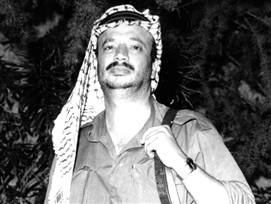
After a 40-year career on the frontline, facing confrontations of many sorts, with his main adversary, and even with members of his own ranks, Mohammed Abdel-Raouf Qudwa Al-Husseini, universally known as Yasser Arafat, popularly nicknamed Abu Ammar, and long since crowned the unrivalled leader of the Palestinian people, has become both a symbol of Palestine and one of its most important unifying factors.
Lying in a sterile hospital room in France, summoning all the strength and will he had left to survive, he must have sought inspiration from that lengthy record of battles from which he has emerged alive and as strong as he was when he entered them, if not stronger.
Arafat's first battle was in 1966. The Syrian authorities had arrested him along with other top Fatah leaders on grounds of incitement to the murder of a key Baathist officer. When a Syrian military tribunal sentenced one of Arafat's companions to death, it seemed as though he and his recently founded Fatah movement were doomed to a premature demise.
Source: [Al Ahram]
Continue reading "The thousand lives of Abu Ammar"
Posted at 10:45 AM in Commentary, Politics | Permalink | Comments (0) | TrackBack
November 06, 2004
Young Bush teaches 'old Europe' a lesson
Amir Taheri
Oh la la! This was the first reaction of the French elite yesterday as they learned about President George W Bush's re-election. Having spent much of Tuesday evening celebrating what they believed would be a landslide win for Senator John F. Kerry, the crème de la crème of chic Paris could not believe that Bush had been returned for four more years.
The European elite had been dreaming about how a President Kerry would ratify the Kyoto accords, sign up to the International Criminal Court, cut and run in Iraq, send flowers to Yasser Arafat, and, perhaps, open a dialogue with Osama Bin Laden.
When it became clear that the American voters wanted none of that, the chattering classes in Europe were left speechless.
Source: [Gulf News]
Continue reading "Young Bush teaches 'old Europe' a lesson"
Posted at 06:53 PM in Commentary | Permalink | Comments (0) | TrackBack
America tells Europe, ‘Shove it’
Maybe woolly-minded, gutless, godless, Europeans had it coming
By Chris Hampson
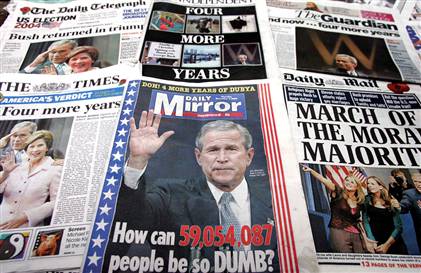 LONDON - I guess those woolly-minded, gutless, godless, liberal Europeans had it coming. No bright new dawn for those condescending, arrogant limeys who think they know what’s best for the world (and look where it got them).
Nor for their "cheese-eating surrender-monkey" neighbors across the Channel in France. Instead — if you believe the newspapers — they woke up with their worst hangover for four years.
America had told us, quite clearly, where we could shove our opinions. (Not difficult in the U.K., because the sun doesn't hardly shine anywhere here).
Source: [MSNBC]
Continue reading "America tells Europe, ‘Shove it’"
Posted at 06:40 PM in Commentary, Features, Politics | Permalink | Comments (0) | TrackBack
November 05, 2004
Deadly Hatreds in the Netherlands
Something sad and terrible is happening to the Netherlands, long one of Europe's most tolerant, decent and multicultural societies. The latest warning sign is this week's brazen murder of Theo van Gogh, a daring filmmaker and columnist descended from the same family as Vincent van Gogh. This summer, Dutch television showed a 10-minute film by Theo van Gogh calling attention to the horrific violence that Muslim women can be subjected to by family members in the name of religion. The chief suspect is believed to be an Islamist extremist, as are eight other men also arrested in connection with the case. [See related story]
Source: [NY Times]
Continue reading "Deadly Hatreds in the Netherlands"
Posted at 04:30 PM in Commentary | Permalink | Comments (0) | TrackBack
The Day the Enlightenment Went Out
By GARRY WILLS
This election confirms the brilliance of Karl Rove as a political strategist. He calculated that the religious conservatives, if they could be turned out, would be the deciding factor. The success of the plan was registered not only in the presidential results but also in all 11 of the state votes to ban same-sex marriage. Mr. Rove understands what surveys have shown, that many more Americans believe in the Virgin Birth than in Darwin's theory of evolution.
This might be called Bryan's revenge for the Scopes trial of 1925, in which William Jennings Bryan's fundamentalist assault on the concept of evolution was discredited. Disillusionment with that decision led many evangelicals to withdraw from direct engagement in politics. But they came roaring back into the arena out of anger at other court decisions - on prayer in school, abortion, protection of the flag and, now, gay marriage. Mr. Rove felt that the appeal to this large bloc was worth getting President Bush to endorse a constitutional amendment banning gay marriage (though he had opposed it earlier).
Source: [NY Times]
Continue reading "The Day the Enlightenment Went Out"
Posted at 03:09 PM in Commentary | Permalink | Comments (0) | TrackBack
Suspected Islamist killing tests Dutch tolerance
By Emma Thomasson
AMSTERDAM, Nov 3 (Reuters) - The killing of a filmmaker critical of Islam puts new strains on Dutch traditions of tolerance and will fuel demands for tougher treatment of immigrants, analysts and commentators said on Wednesday.
Theo van Gogh, who angered Muslims with a film that said Islam encouraged
violence against women, was shot dead on Tuesday. A man with Dutch and Moroccan
nationality was arrested for the killing, and suspected of Islamic extremist
motives. [See related story]
Source [Reuters Alertnet]
Continue reading "Suspected Islamist killing tests Dutch tolerance"
Posted at 02:56 PM in Commentary, Culture almighty, Politics, Religion | Permalink | Comments (0) | TrackBack
October 24, 2004
Liberation Online: A look at Iraq's bloggers
BY BRUCE CHAPMAN
BAGHDAD, Iraq--Basking in the sun by the Al Hamra Hotel swimming pool, a Spanish journalist complained to me that "all my editors want is blood, blood, blood. No context. No politics."
Such editors are cruising to be scooped by such local Iraqi blogs as Iraq the Model, which last summer debunked a Los Angeles Times story on the departure of Coalition Provisional Authority head L. Paul Bremer. The Times told its readers that Bremer had fled abruptly, "afraid to look in the eye the people he had ruled for more than a year." In fact, as Iraq the Model reported, Mr. Bremer before leaving delivered a television address that gave a moving account of his tenure and his hopes for the new all-Iraqi interim government.
The bloggers had heard it, the L.A. Times reporter had not. The paper ultimately had to correct its account, though never acknowledging the indignant Iraqis who caught its snide oversight.
Source: [Opinion Journal]
Continue reading "Liberation Online: A look at Iraq's bloggers"
Posted at 09:13 PM in Commentary, War, Weblogs | Permalink | Comments (0) | TrackBack
October 17, 2004
'Oops. I Told the Truth'
By THOMAS L. FRIEDMAN
Sometimes it's useful to stand back and ask yourself: If I could vote for anyone for president other than George W. Bush or John Kerry, whom would I choose? I'd choose Bill Cosby - on the condition that he would talk as bluntly to white parents and kids about what they need to do if they want to succeed as he did to black kids and parents a few months ago.
The one thing that has gone totally missing, not only from this election, but from American politics, is national leaders who are actually ready to level with the public and even criticize their own constituencies. The columnist Michael Kinsley once observed that in American politics "a gaffe is when a politician tells the truth." We could use a few really big gaffes right now. Because we have not one, but three baby booms bearing down at us, and without a massive injection of truth-telling they could all explode on the next president's watch.
Source: [NY Times]
Continue reading "'Oops. I Told the Truth'"
Posted at 08:39 PM in Commentary | Permalink | Comments (1) | TrackBack
October 10, 2004
The Other Intelligence Failure In Iraq - `PMD'
Thomas Friedman
Much attention was rightly paid last week to the huge intelligence failure of the Bush team in Iraq. Saddam Hussein had no WMD. But I would argue that there is another, equally egregious intelligence failure when it comes to Iraq, one that is still bedeviling us right now: It is our complete ignorance about the PMD of Iraq - the people of mass destruction, the suicide bombers - and the environment that nurtures them.
Let's start with a simple observation: There have been some 125 suicide bomb attacks against U.S. forces in Iraq in the last 16 months, carried out most likely by Sunni Muslims. We need to think about this. There is some kind of suicide-supply chain working in the Muslim world and in Iraq that is able to draw recruits, connect them with bomb makers and deploy them tactically against U.S. and Iraqi targets on an almost daily basis. What is even more unnerving about these suicide bombers is that, unlike the Hamas crew in Israel, who produce videos of themselves, explain their rationale and say goodbye to families, virtually all the bombers in Iraq have blown themselves up without even telling us their names.
Source: [NY Times]
Continue reading "The Other Intelligence Failure In Iraq - `PMD'"
Posted at 03:03 PM in Commentary | Permalink | Comments (0) | TrackBack
October 07, 2004
The Battle of the Pump
By Thomas Friedman
Of all the shortsighted policies of President Bush and Vice President Dick Cheney, none have been worse than their opposition to energy conservation and a gasoline tax. If we had imposed a new gasoline tax after 9/11, demand would have been dampened and gas today would probably still be $2 a gallon. But instead of the extra dollar going to Saudi Arabia - where it ends up with mullahs who build madrasas that preach intolerance - that dollar would have gone to our own Treasury to pay down our own deficit and finance our own schools. In fact, the Bush energy policy should be called No Mullah Left Behind.
Source: [NY Times]
Continue reading "The Battle of the Pump"
Posted at 02:47 PM in Commentary | Permalink | Comments (0) | TrackBack
October 03, 2004
Iraq: Politics or Policy?
By THOMAS L. FRIEDMAN
Sorry, I've been away writing a book. I'm back, so let's get right down to business: We're in trouble in Iraq.
I don't know what is salvageable there anymore. I hope it is something decent and I am certain we have to try our best to bring about elections and rebuild the Iraqi Army to give every chance for decency to emerge there. But here is the cold, hard truth: This war has been hugely mismanaged by this administration, in the face of clear advice to the contrary at every stage, and as a result the range of decent outcomes in Iraq has been narrowed and the tools we have to bring even those about are more limited than ever.
Source: [NY Times]
Continue reading "Iraq: Politics or Policy?"
Posted at 01:59 PM in Commentary | Permalink | Comments (0) | TrackBack