November 23, 2006
The Lebanese crisis explained
 By Roger Hardy
Lebanon is the most politically complex and religiously divided country in the Middle East, which is what makes it such a potentially explosive factor in an unstable region. Tiny Lebanon baffles outsiders. Even people in the Middle East find its politics confusing. Set up by France after World War I as a predominantly Christian state, Lebanon is now about 60% Muslim, 40% Christian.
It has 18 officially recognised religious sects and sharing power between them has always been a complicated game. Lebanese Muslims have tended to look east for support from the other Arab states and from Iran. The Christians have tended to look west to Europe and the United States.
The country's proximity to Israel - and the presence of a large number of Palestinian refugees on its soil - mean it is also intimately tied to the Arab-Israeli dispute. While Lebanon has plenty of problems of its own, it has also become the arena where many of the region's conflicts and rivalries are played out.
Source: [BBC]
Continue reading "The Lebanese crisis explained "
Posted at 11:00 AM in Analysis, La Revolutione | Permalink | Comments (0) | TrackBack
August 22, 2006
Watching Lebanon: Washington's interests in Israel's war
By Seymour M. Hersh
In the days after Hezbollah crossed from Lebanon into Israel, on July 12th, to kidnap two soldiers, triggering an Israeli air attack on Lebanon and a full-scale war, the Bush Administration seemed strangely passive. "It's a moment of clarification," President George W. Bush said at the G-8 summit, in St. Petersburg, on July 16th.
"It's now become clear why we don't have peace in the Middle East." He described the relationship between Hezbollah and its supporters in Iran and Syria as one of the "root causes of instability," and subsequently said that it was up to those countries to end the crisis. Two days later, despite calls from several governments for the United States to take the lead in negotiations to end the fighting, Secretary of State Condoleezza Rice said that a ceasefire should be put off until "the conditions are conducive."
The Bush Administration, however, was closely involved in the planning of Israel's retaliatory attacks. President Bush and Vice-President Dick Cheney were convinced, current and former intelligence and diplomatic officials told me, that a successful Israeli Air Force bombing campaign against Hezbollah's heavily fortified underground-missile and command-and-control complexes in Lebanon could ease Israel's security concerns and also serve as a prelude to a potential American preëmptive attack to destroy Iran's nuclear installations, some of which are also buried deep underground.
Source: [The New Yorker]
Continue reading "Watching Lebanon: Washington's interests in Israel's war"
Posted at 01:49 PM in Analysis, La Revolutione, War | Permalink | Comments (0) | TrackBack
August 13, 2006
The day the enemy became 'Islamic fascists'
By Kari Huus and Tom Curry
News from London Thursday morning that British intelligence agents had foiled a potential new terrorist plot in its advanced stages prompted the highest level security alert in the United States since 9/11, and brought trans-Atlantic travel to its knees.
It was a "stark reminder," President Bush said in his first public reaction to the events, that "this nation is at war with Islamic fascists," seeking to destroy freedom-loving societies. At this dramatic moment, it was not "war with terrorism," as the president characterized events shortly after the Sept. 11 attacks, or a "war on terror," as he has referred to it more commonly over time.
Instead, the war was now with "Islamic fascists" -- a term that has rarely been used by the president before this week. Was it used in the heat of the moment, or was the president rolling out a new way of explaining U.S. policy -- choosing new words to explain and solidify support?
Source: [MSNBC]
Continue reading "The day the enemy became 'Islamic fascists'"
Posted at 01:17 PM in Analysis, Extremism, Politics, Religion | Permalink | Comments (0) | TrackBack
May 12, 2006
Jordan's Islamists reap inspiration from Hamas
By Hassan M. Fattah
AMMAN (NY Times) Emboldened by the Muslim Brotherhood's electoral gains in Egypt last year and by the rise to power of Hamas in the Palestinian elections in February, Islamists in Jordan have raised their sights, preparing to take part in possible council elections this year and parliamentary elections next year. The Islamic Action Front, the Muslim Brotherhood's political party, which controls 17 of the 110 seats in Parliament, is betting that it can now ride a popular wave to win a significant majority and maybe even form a government some day.
"We are a political party and it is natural for us to seek to come to power one day," said Rohile Ghraibeh, deputy secretary general of the Islamic Action Front. "If we were to win, is that worthy of any fear? We would consider it a blessing from God."
There is little chance of an Islamist government under this nation's current political system: King Abdullah has the power to bypass lawmakers in forming a government and can dissolve Parliament by decree. But the Islamists' bluster and the government's reaction have increased tensions here. In the most significant case, security officials announced in late April that they had arrested several men with ties to Hamas who had been tracked smuggling weapons into Jordan from Syria.
Source: [International Herald Tribune]
Continue reading "Jordan's Islamists reap inspiration from Hamas "
Posted at 10:06 AM in Analysis, Jordan in the news, Politics | Permalink | Comments (0) | TrackBack
April 20, 2006
Jordan and Hamas: A love-hate relationship
By Oreib Rintawi
AMMAN, Jordan (UPI) -- Jordan's relationship with Palestinian militant group Hamas has gone through many ups and downs over the past two decades. But the most serious challenge to the relationship since 1999, when Amman closed Hamas' offices and evicted four of its leaders, occurred Tuesday following accusations that the group was smuggling arms to Jordan as a prelude to attacking vital targets.
Only hours before the minister of foreign affairs in the Hamas government, Mahmoud Zahhar, was scheduled to visit Amman, the government disclosed information that Hamas planed to target Jordan and had built up a stockpile of arms on Jordanian territory.
The development, denied by Hamas and Jordan's outlawed but tolerated Muslim Brotherhood Organization, resulted in the cancellation of Zahhar's visit, which was part of a Middle East tour aimed at garnering political and financial support for the Palestinian Authority. Hamas' presence in Jordan dates back to the early 1990s, and its pioneer members were Jordanians of Palestinian origin affiliated with the Muslim Brotherhood.
Source: [Monsters and Critics]
Continue reading "Jordan and Hamas: A love-hate relationship"
Posted at 01:33 PM in Analysis, Jordan in the news, Politics | Permalink | Comments (0) | TrackBack
April 19, 2006
Egyptian riots reveal wide religious divide
 By Ursula Lindsey
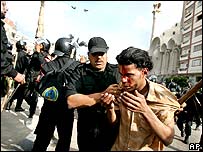
ALEXANDRIA, EGYPT -- An attack on several Christian churches in this Egyptian coastal city, followed by two days of sectarian clashes, raises fresh concerns that the social compact between the country's Muslim majority and Coptic Christian minority is unraveling. While the government and many Egyptians say religious tolerance is the rule, some in the country's Coptic community view the attack, and the way the investigation is being handled, as evidence they are increasingly under siege.
On Sunday evening, Christians and Muslims came together for a peaceful march in a neighborhood where some of the clashes occurred. The demonstrators, led by Muslim and Christian clergy, chanted "Long live the crescent and the cross," referring to the symbols of their two religions. It's a slogan that has its roots in Egypt's 1919 Independence movements, when Christians and Muslims came together to protest British occupation, and the idea of "national unity" - regardless of creed - was forged. But that solidarity has been under strain since the 1970s, which witnessed the rise of violent Islamist groups in Egypt and the increased religiosity of average citizens.
Source: [Christian Science Monitor]
Continue reading "Egyptian riots reveal wide religious divide"
Posted at 09:00 AM in Analysis, Religion | Permalink | Comments (0) | TrackBack
April 11, 2006
Report: US military magnifies Zarqawi role in Iraq War
 By Thomas E. Ricks
The U.S. military is conducting a propaganda campaign to magnify the role of the leader of al-Qaeda in Iraq, according to internal military documents and officers familiar with the program. The effort has raised his profile in a way that some military intelligence officials believe may have overstated his importance and helped the Bush administration tie the war to the organization responsible for the Sept. 11, 2001, attacks.
The documents state that the U.S. campaign aims to turn Iraqis against Abu Musab al-Zarqawi, a Jordanian, by playing on their perceived dislike of foreigners. U.S. authorities claim some success with that effort, noting that some tribal Iraqi insurgents have attacked Zarqawi loyalists.
For the past two years, U.S. military leaders have been using Iraqi media and other outlets in Baghdad to publicize Zarqawi's role in the insurgency. The documents explicitly list the "U.S. Home Audience" as one of the targets of a broader propaganda campaign. Some senior intelligence officers believe Zarqawi's role may have been overemphasized by the propaganda campaign, which has included leaflets, radio and television broadcasts, Internet postings and at least one leak to an American journalist.
Source: [Washington Post]
Continue reading "Report: US military magnifies Zarqawi role in Iraq War"
Posted at 03:00 PM in Analysis, Politics, War | Permalink | Comments (0) | TrackBack
February 16, 2006
Anatomy of the cartoon protest movement
By Anthony Shadid and Kevin Sullivan
BEIRUT, Lebanon - It was Oct. 13 when Teguh Santosa, a 30-year-old editor with wire-rim glasses, slicked-back black hair and a stubbly beard, decided to make a point in Indonesia, the world's most populous Muslim country. His idea was a small gesture in a broader confrontation, illustrating the power of images in shaping sentiments. He scanned a dozen cartoons published in September by a Danish newspaper that lampooned the prophet Muhammad and chose to publish the one on his news Web site that has proven the most inflammatory: the prophet wearing a turban shaped like a bomb with a lit fuse.
"I wanted them to know why it was insulting," said the thickset Santosa, a Muslim who runs the widely read Rakyat Merdeka Online.To his surprise, there was almost no reaction. A few e-mailed comments to the Web site, he said. That was all. So he republished the caricature more than a week later, on Oct. 22. Again, nothing.
"We were confused," he recalled, his sleeves rolled up to his elbows. "Why aren't people reacting to this story?" What followed was a quintessentially 21st-century battle, a conflict steeped in decades, even centuries of grievances, reshaped by the attacks of Sept. 11, 2001, and their aftermath.
Source: [Washington Post]
Continue reading "Anatomy of the cartoon protest movement "
Posted at 05:42 PM in Analysis, Cartoon rows | Permalink | Comments (0) | TrackBack
November 07, 2005
France's Riots: The Fire This Time
 By Christopher Dickey
Word of the deaths spread quickly through Clichy-sous-Bois, a grim collection of housing projects an hour by train and bus from the center of Paris. Two teenage boys had been electrocuted while trying to hide near a transformer. Rumor said they were running from police. Soon, dozens of angry young men came from the soulless high-rises looking for cops to fight and cars to burn on streets named, as it happens, for heroes of French culture: Boulevard Emile Zola, Allee Albert Camus, Rue Picasso. Dead white men.
"It's Baghdad here," the rioters shouted. By the end of that first night, Oct. 27, police would count 15 cars torched and six arrests. No firefighters or cops were injured and authorities claimed the situation was stabilized. But they were very wrong. Night after night last week rage spread through the ghettos that ring Paris, then beyond -- to the slums of Dijon in Burgundy, Rouen in Normandy, Toulouse, Rennes, Marseilles.
When, on the fourth night, a tear-gas canister exploded near the entrance to a warehouselike mosque in Clichy-sous-Bois, forcing hundreds of worshipers to flee barefoot and gagging into Place Anatole France, a new cry went up from the vandals. "Now this is war," said one. Others cried "jihad."
Source: [Newsweek]
Continue reading "France's Riots: The Fire This Time"
Posted at 11:23 PM in Analysis, Developing story, Disturbing report | Permalink | Comments (0) | TrackBack
September 20, 2005
The UN probe and Syria's survival game
By Claude Salhani
THE assignment given to Detlev Mehlis, the United Nations' German super-cop, by UN Secretary General Kofi Annan, was by no means an enviable one. It must have been the equivalent of stepping into a wasp's nest, stirring it up while at the same time asking for their diligent cooperation.
Still, Mehlis, who was tasked with investigating the Feb. 14 assassination of former Lebanese prime minister Rafik Al Hariri, has made considerable headway, despite lack of cooperation from pro-Syrian Lebanese and Syrian officials who would have much rather seen the whole affair swept under the proverbial rug.
But despite the obstacles, Mehlis persisted. His investigation produced amazing results leading to the arrests of half-a-dozen top Lebanese official, including the heads of internal and general security. This sort of investigation was unheard of in an Arab country, where the top brass traditionally felt immune from prosecution.
Source: [Khaleej Times]
Continue reading "The UN probe and Syria's survival game"
Posted at 02:04 PM in Analysis, Conspiracies, La Revolutione | Permalink | Comments (0) | TrackBack
September 19, 2005
Bloodcurdling Al Qaeda threats, now in English
American intel officials believe three recent Qaeda videotapes represent a new strategy by Osama bin Laden's network to get more air time in English-speaking countries. Since early August, three different, and seemingly current, videotapes have surfaced featuring masked English-speakers uttering chilling threats.
The English tapes may be aimed at getting lengthier and wider exposure for the terrorists' messages in target countries like the United States and Britain. Customarily, U.S. media have shown only snippets of Arabic-language videos featuring Qaeda bigwigs like bin Laden and his deputy Ayman al-Zawahiri. "Their view is that their propaganda will get more air time and column inches by using English-speakers," said a senior U.S. counterterrorism official, who asked not to be identified because he was talking about intelligence issues.
The first new video, which got major attention Down Under, surfaced in early August on the Al Arabiya television network. Entitled "The War of the Oppressed People," the tape included sound bites from a hooded man carrying an AK-47. In an Australian accent, he declared, "The Muslim world is not your backyard. The honorable sons of Islam will not let you kill our sons... As you kill, you will be killed. As you bomb, you will be bombed."
Source: [Newsweek]
Continue reading "Bloodcurdling Al Qaeda threats, now in English"
Posted at 09:00 PM in Analysis, Terrorism | Permalink | Comments (1) | TrackBack
September 10, 2005
Egyptian elections flawed, but no turning back
By Charlene Gubash
CAIRO -- For the first time since independence, Egyptians were able to vote for more than one candidate in a national election this week. And despite the fact that President Hosni Mubarak won a fifth six-year term with 80 percent of the vote amid allegations of election irregularities, many consider the process itself an irreversible step forward.
"Many Egyptians see it in a positive way, the impact of the overall process had been the politicization of Egyptian society, which had been depoliticized for decades," explained Dr. Gamal Abdel Gawad, senior political analyst at the Al Ahram Center for Political and Strategic Studies in Cairo.
"Now there is a kind of vibrant political debate and activism. There is a wider political space," Gawad SAID.
Source: [MSNBC]
Continue reading "Egyptian elections flawed, but no turning back"
Posted at 08:25 AM in Analysis, La Revolutione | Permalink | Comments (0) | TrackBack